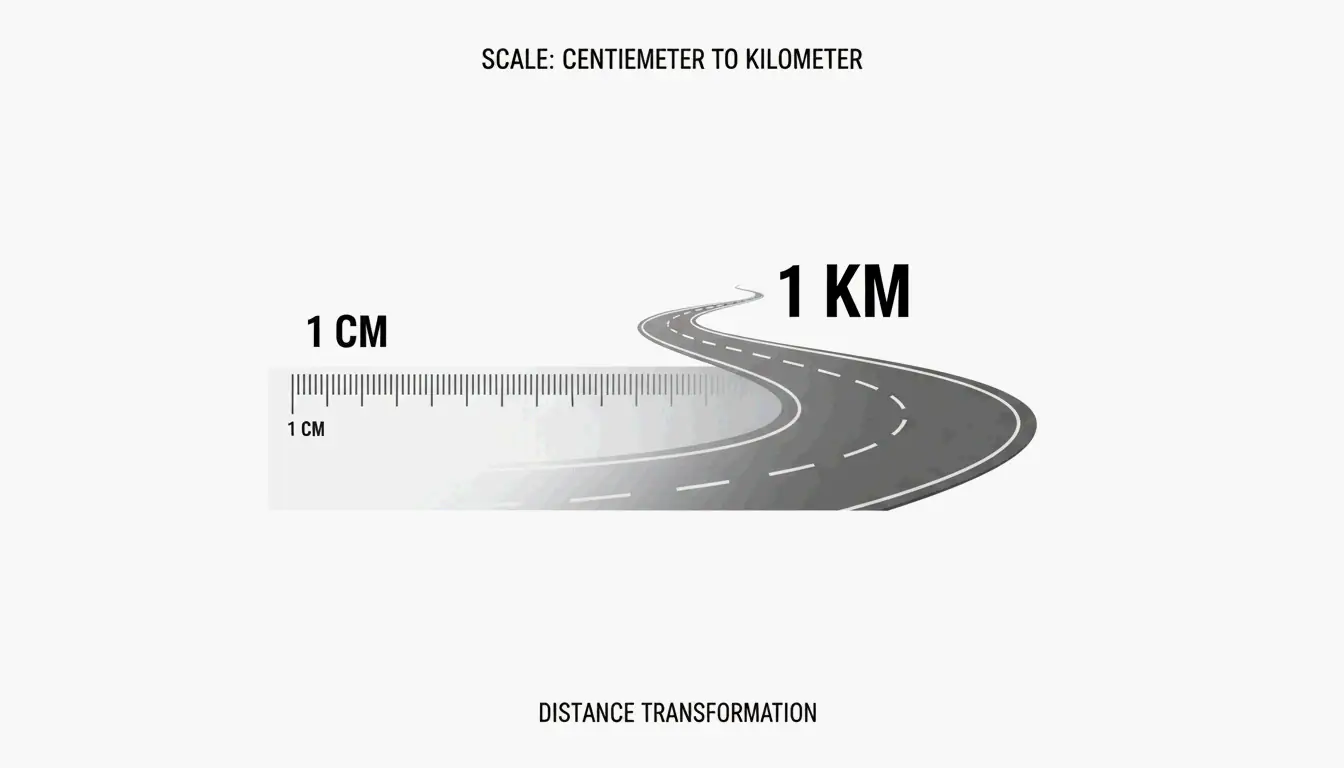
To convert centimeters (cm) to kilometers (km), divide by 100,000. The formula is km = cm ÷ 100,000 (or equivalently, km = cm × 0.00001). For example, 250,000 cm = 2.5 km. Per NIST, the conversion factor is exactly 10⁻⁵.
The Conversion Formula
| Method | Formula | Example |
|---|---|---|
| Division | km = cm ÷ 100,000 | 500,000 cm = 5 km |
| Multiplication | km = cm × 0.00001 | 500,000 cm = 5 km |
| Decimal shift | Move decimal 5 places left | 250,000 → 2.5 km |
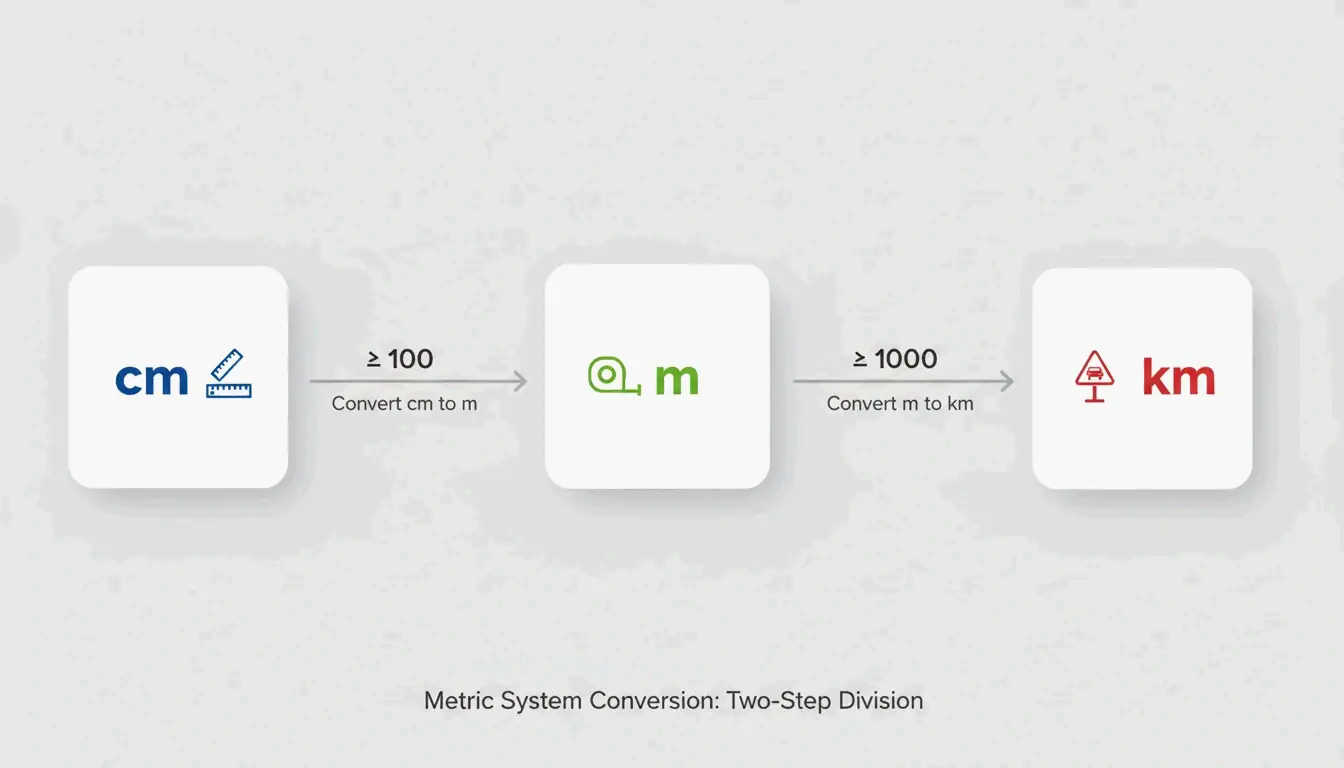
Two-Stage Method (via Meters)
- cm → m: Divide by 100 (e.g., 100,000 cm = 1,000 m)
- m → km: Divide by 1,000 (e.g., 1,000 m = 1 km)
Step-by-Step: Manual Conversion
- Identify the value — e.g., 250,000 cm
- Find the decimal point — 250,000.0
- Shift 5 places left — 2.50000 → 2.5 km
Quick Conversion Table
| Centimeters | Kilometers | Scientific Notation |
|---|---|---|
| 1 cm | 0.00001 km | 1 × 10⁻⁵ km |
| 100 cm | 0.001 km | 1 × 10⁻³ km |
| 1,000 cm | 0.01 km | 1 × 10⁻² km |
| 10,000 cm | 0.1 km | 1 × 10⁻¹ km |
| 45,000 cm | 0.45 km | 4.5 × 10⁻¹ km |
| 100,000 cm | 1 km | 1 × 10⁰ km |
| 250,000 cm | 2.5 km | 2.5 × 10⁰ km |
| 1,000,000 cm | 10 km | 1 × 10¹ km |
As CoolConversion notes, describing a distance as 0.45 km is far more practical than 45,000 cm.
Why the Metric System Uses This Scale
The metric system is decimal-based, governed by ISO 80000-3 for length units. A centimeter measures small objects (button width, pencil thickness). A kilometer measures geographic distances (road lengths, city-to-city). The 100,000:1 ratio keeps both scales manageable.
Visualizing the Scale
| Object | Measurement | Scale |
|---|---|---|
| Paperclip thickness | ~1 cm | Hand-held |
| Pencil width | ~0.7 cm | Hand-held |
| 10-minute brisk walk | ~1 km | Navigational |
| 1.5 km road segment | 150,000 cm | Navigational |
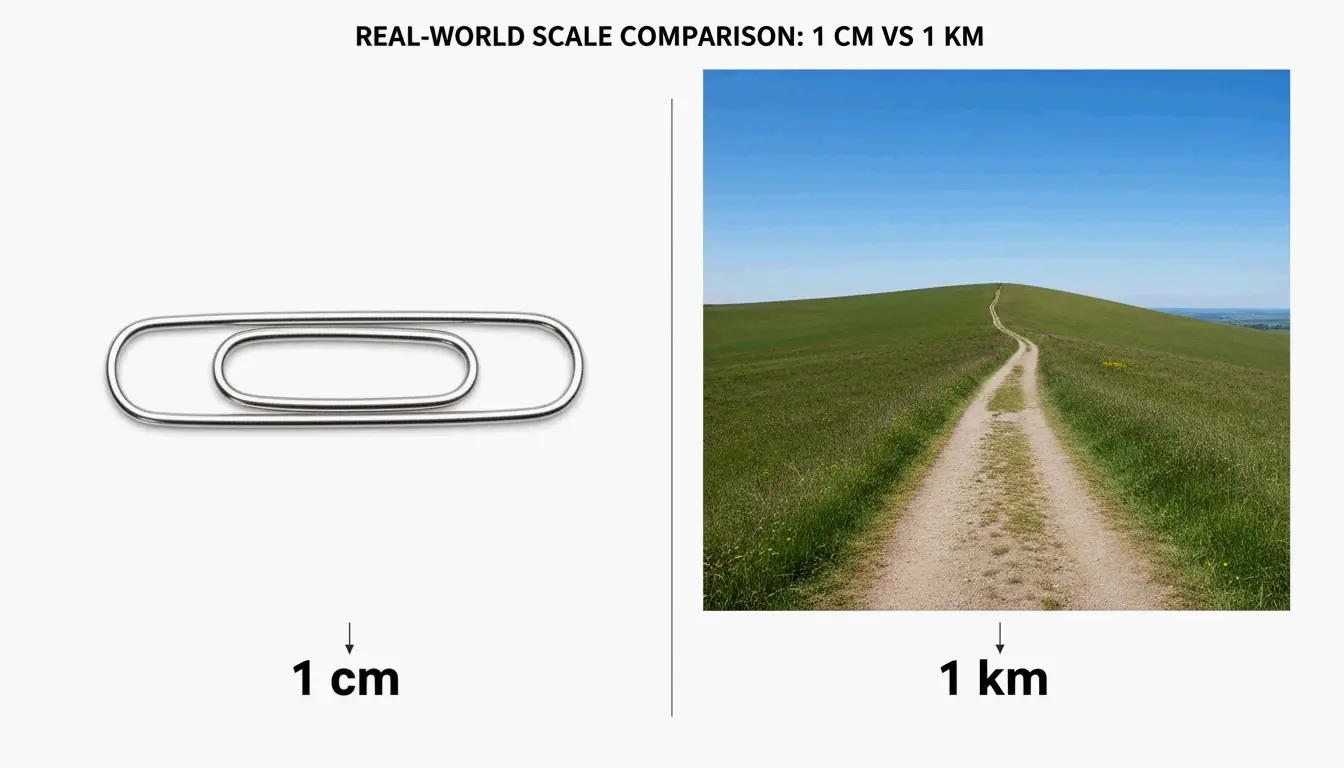
Per CoolConversion, 0.001 cm is thinner than pencil lead (microscopic), while 150,000 cm represents a 1.5 km road segment.
Speed Conversion: cm/s to km/h
To convert centimeters per second (cm/s) to kilometers per hour (km/h), multiply by 0.036.
| Formula | Derivation |
|---|---|
| km/h = cm/s × 0.036 | (cm ÷ 100,000) × 3,600 seconds |
| cm/s | km/h |
|---|---|
| 1 cm/s | 0.036 km/h |
| 100 cm/s | 3.6 km/h |
| 1,000 cm/s | 36 km/h |
| 10,000 cm/s | 360 km/h |
| 100,000 cm/s | 3,600 km/h |
Per Tradukka, this conversion is essential for drone altitude tracking, conveyor belt rates, and robotics.
Scientific Notation Reference
Per CoolConversion, 90,000 cm = 9 × 10⁴ cm = 0.9 km. For extremely small values, 0.01 cm = 1 × 10⁻⁷ km.
| Precision Level | Format | Example |
|---|---|---|
| Everyday | Decimal | 2.5 km |
| Engineering | Scientific notation | 2.5 × 10⁰ km |
| Standards compliance | NIST factor | 250,000 cm × 10⁻⁵ |
Conclusion
cm to km = divide by 100,000 (decimal shift 5 places left). For speed, multiply cm/s by 0.036 to get km/h. For professional or scientific work, verify against NIST and ISO 80000-3 standards.
FAQ
How many kilometers are in 1 centimeter?
0.00001 km (1 × 10⁻⁵ km). This is an exact metric conversion per NIST.
What is the conversion factor between cm and km?
1/100,000 = 0.00001. Multiply cm by 0.00001 or divide by 100,000.
How do I convert cm/s to km/h?
Multiply cm/s by 0.036. Formula: (cm ÷ 100,000) × 3,600 = km/h.
Is this different from imperial system conversions?
Yes. cm-to-km is purely metric (SI), based on powers of ten. Imperial units (inches, feet, miles) use non-decimal factors and require entirely different conversion formulas.
Leave a Reply