Category: Story

  • CM to Feet and Inches: Ultimate Conversion Guide & Height Chart (2026)

    CM to Feet and Inches: Ultimate Conversion Guide & Height Chart (2026)

    To convert cm to feet and inches: divide cm by 2.54 to get total inches, then divide by 12 for feet with the remainder as inches. Example: 180 cm = 70.87 in = 5’10.9″. Per NIST SP 811, 1 foot = exactly 30.48 cm, 1 inch = exactly 2.54 cm.

    The 3-Step Formula

    Step Operation Example (180 cm)
    1. Total inches cm ÷ 2.54 180 ÷ 2.54 = 70.866 in
    2. Feet total inches ÷ 12 (whole number) 70.866 ÷ 12 = 5 ft
    3. Remaining inches decimal remainder × 12 0.866 × 12 = 10.4 in
    Result 5’10.4″

    Alternative for Step 3: (original cm − feet × 30.48) ÷ 2.54 = remaining inches.

    Never round 2.54 to 2.5 — this creates a 1.6% error that compounds in construction and medical records.

    Height Chart: CM to Feet & Inches

    Centimeters Feet & Inches (rounded) Exact Imperial Context
    150 cm 4’11” 4’11.06″
    155 cm 5’1″ 5’1.02″
    159 cm 5’3″ 5’2.99″ Global avg female
    160 cm 5’3″ 5’2.99″
    165 cm 5’5″ 5’4.96″
    170 cm 5’7″ 5’6.93″
    171 cm 5’7″ 5’7.32″ Global avg male
    175 cm 5’9″ 5’8.90″
    180 cm 5’11” 5’10.87″
    185 cm 6’1″ 6’0.83″
    190 cm 6’3″ 6’2.80″
    200 cm 6’7″ 6’6.74″

    Height averages per GIGAcalculator.

    Diurnal Variation

    Humans are tallest in the morning and can “shrink” by up to 1 cm (0.39 in) by evening as spinal discs compress from standing.

    Decimal Feet ≠ Feet + Inches

    Critical trap: 5.8 feet is NOT 5’8″ — it’s 5’9.6″ (0.8 × 12 = 9.6 in).

    Misread Actual Difference
    5.8 ft read as 5’8″ Actual: 5’9.6″ +1.6 inches
    6.1 ft read as 6’1″ Actual: 6’1.2″ +0.2 inches
    5.5 ft read as 5’5″ Actual: 5’6.0″ +1.0 inches

    A side-by-side visual comparison showing why 5.8 feet is taller than 5'8".

    Decimal Inches to Fractions (Construction)

    For US tape measures (base-16):

    Decimal Inches × 16 Fraction
    0.25 in 4/16 1/4″
    0.50 in 8/16 1/2″
    0.75 in 12/16 3/4″
    0.0625 in 1/16 1/16″
    0.4375 in 7/16 7/16″

    Multiply the decimal portion by 16, round to nearest whole number, simplify the fraction.

    Standards: 1959 Agreement & US Survey Foot

    Standard Definition Status (2026)
    International foot 1 ft = 30.48 cm exactly Active
    International inch 1 in = 2.54 cm exactly Active
    US Survey Foot ~2 ppm different from international Retired Jan 1, 2023 per NIST

    The meter is defined by the speed of light (299,792,458 m/s) per the BIPM.

    Practical: Furniture & Home Conversion (IKEA)

    Item Metric (cm) Imperial US Standard Difference
    European Queen bed 160 cm wide 62.99 in US Queen: 60 in +3 inches wider
    European ceiling 250 cm 8’2.4″ US ceiling: 8′ (243.84 cm) +2.4 inches taller
    Standard door 200 cm 6’6.7″ US door: 6’8″ (203.2 cm) −2.5 inches shorter

    Contractors must use the exact 2.54 factor when installing imported cabinets or appliances.

    Child Height Prediction

    Method Accuracy Requirements
    Multiplier Method (Paley et al.) 85% within 5 cm Child’s current height + age
    Khamis-Roche More precise Both parents’ heights required

    Per GIGAcalculator, the Multiplier Method works across ethnicities and requires less input data.

    Conclusion

    cm → total inches (÷2.54) → feet (÷12) + remaining inches. Never confuse decimal feet with feet+inches. For construction, convert decimal inches to 1/16th fractions. For furniture imports, check exact cm dimensions against US standards before purchasing.

    FAQ

    Why is 5.8 feet not the same as 5’8″?

    Feet use decimal (base-10) but inches use base-12. Multiply the decimal portion by 12: 0.8 × 12 = 9.6 inches. So 5.8 feet = 5’9.6″, nearly 2 inches taller than 5’8″.

    What is the average global height?

    Per GIGAcalculator: men 171 cm (5’7″), women 159 cm (5’3″). Varies significantly by region — the Netherlands averages are notably higher.

    How do I convert decimal inches to fractions for construction?

    Multiply the decimal portion by your target denominator (16 for 1/16ths), round to the nearest whole number, and simplify. Example: 0.75 × 16 = 12/16 = 3/4 inch.

  • What Is WAV Audio Format? Professional Guide to Lossless Sound (2026)

    What Is WAV Audio Format? Professional Guide to Lossless Sound (2026)

    The WAV format (Waveform Audio File Format) is an uncompressed audio container by Microsoft and IBM that stores raw PCM data — preserving 100% of original sound quality. It uses roughly 10 MB per minute of audio at CD quality. In 2026, WAV remains the standard for professional mastering, studio recording, and AI audio workflows.

    WAV Technical Structure

    Component Role
    RIFF Header Identifies file format and overall structure
    fmt Chunk Sample rate, bit depth, channels, byte rate
    data Chunk Raw PCM audio samples

    Wikipedia notes WAV launched in 1991 as the native uncompressed sound format for Windows.

    Bit Depth and Sample Rate Settings

    Setting Bit Depth Sample Rate File Size (per min) Use Case
    CD Quality 16-bit 44.1 kHz ~10.1 MB Standard digital distribution
    Film/TV 16-bit 48 kHz ~11 MB BBC broadcast standard per Wikipedia
    Professional Studio 24-bit 48 kHz ~16.5 MB Film, TV, studio production
    High-Res 24-bit 96 kHz ~33 MB Archival, mastering
    32-bit Float 32-bit float 48 kHz+ ~22 MB+ Field recording, clipping prevention

    Flipper File confirms CD-quality audio requires 10.1 MB per minute.

    32-bit Float: Clipping Prevention

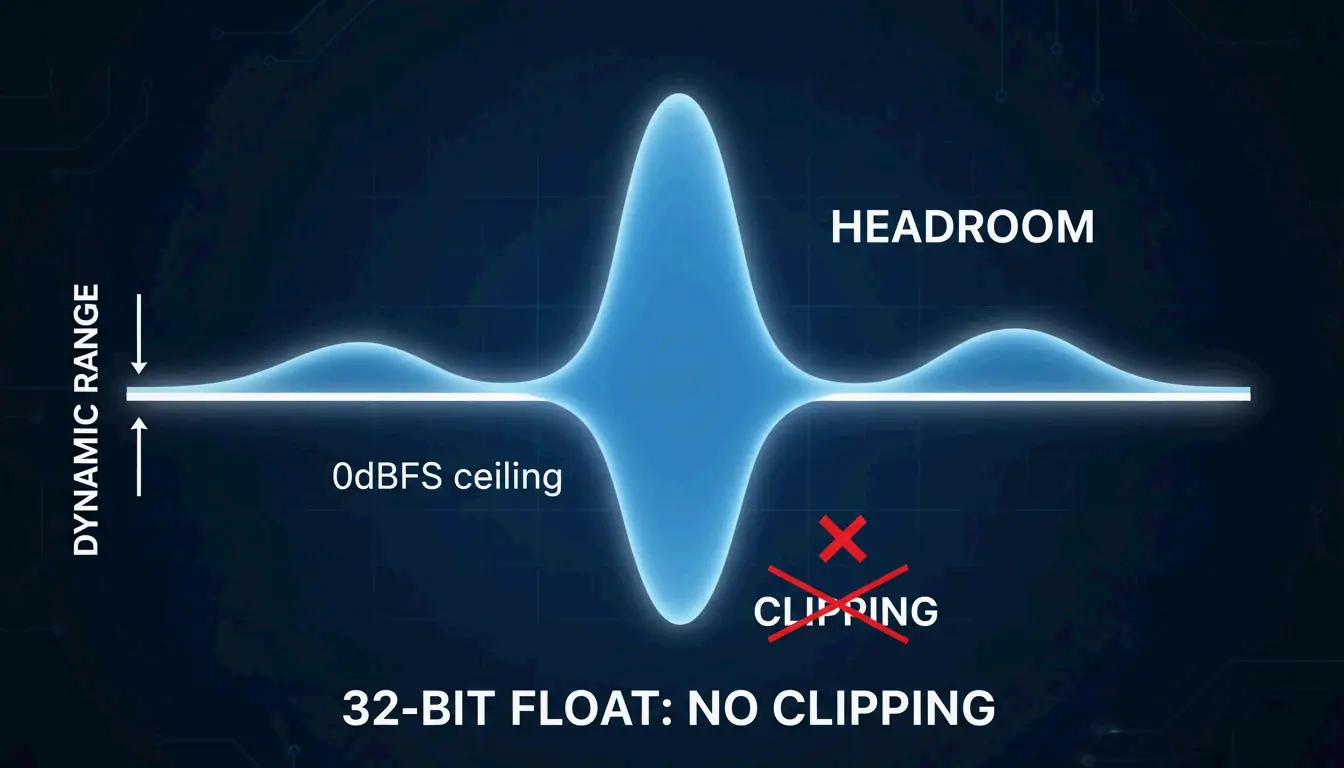
    32-bit float offers a dynamic range of up to 1,528 dB, making it nearly impossible to clip during recording. If audio exceeds the input level, you can recover it perfectly in post-production — impossible with 16-bit or 24-bit.

    A visual metaphor for 32-bit float headroom, showing a wave that exceeds a boundary but remains intact/retrievable.

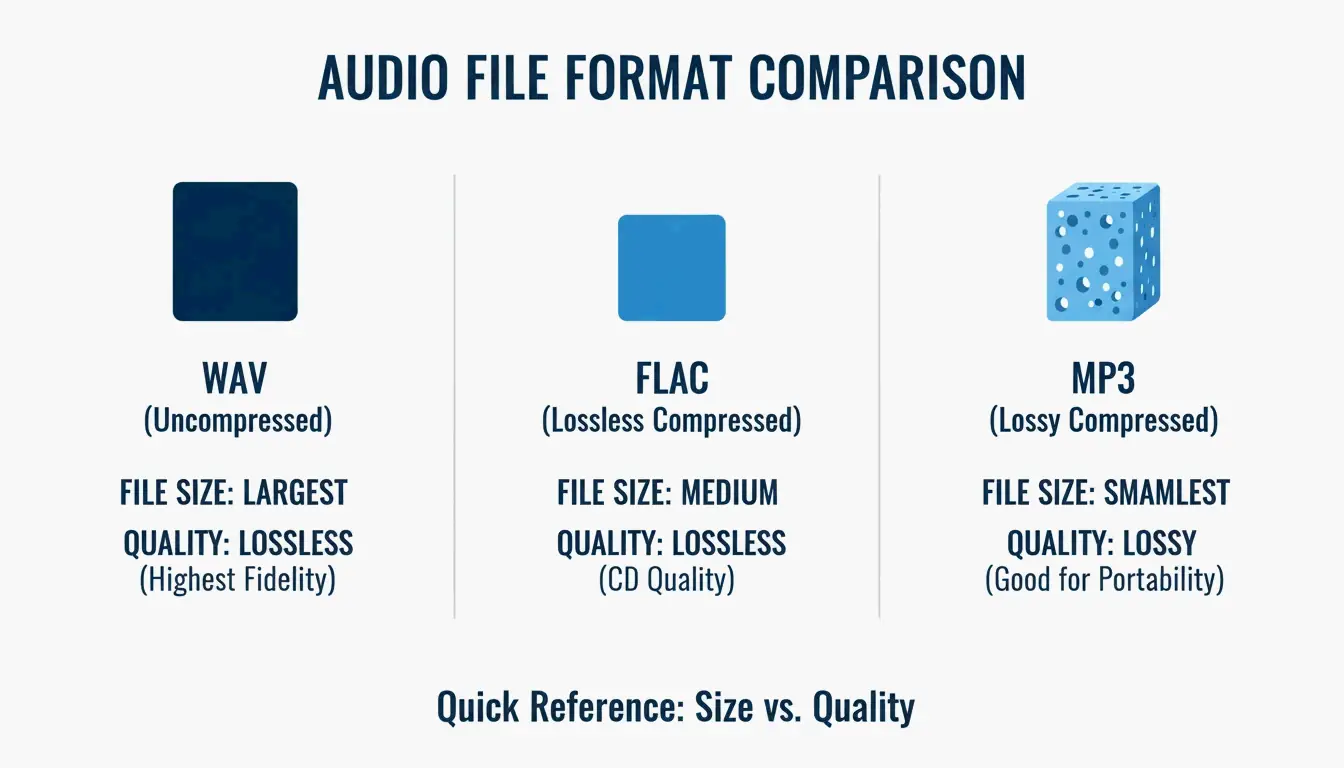
    WAV vs. FLAC vs. MP3

    Format Compression Quality Size (per min) CPU Decode Best For
    WAV None (raw PCM) 100% lossless ~10 MB Zero Recording, mixing, DJing
    FLAC Lossless Mathematically identical ~5 MB Low Archival, streaming
    MP3 Lossy Perceptually close at 320 kbps ~2.4 MB Low Casual listening, sharing

    Studio Supplies notes FLAC reduces size by 50–60% while keeping audio mathematically identical. Per FastPix, even pro engineers struggle to distinguish 320 kbps MP3 from WAV in blind tests — but discarded MP3 data is gone forever.

    A simple 3-way comparison of WAV, FLAC, and MP3 focusing on the trade-off between file size and data integrity.

    The 4GB File Size Limit

    The original RIFF header uses a 32-bit unsigned integer for file size, capping at 4 GB. Workarounds:

    Extension Max Size Maintainer
    RF64 Virtually unlimited European Broadcasting Union
    W64 Virtually unlimited Sound Forge

    WAV for AI Audio Workflows (2026)

    FastPix reports AI noise reduction and frequency repair tools require lossless source files. Starting from MP3 deprives AI models of the high-frequency data they need — WAV is the only way to get professional AI audio results.

    Conversion: FFmpeg Commands

    
    ffmpeg -i input.wav -codec:a libmp3lame -b:a 320k output.mp3
    
    # WAV to FLAC
    ffmpeg -i input.wav -codec:a flac output.flac
    
    # WAV to OAC (Open Audio Codec, 2026)
    ffmpeg -i input.wav -codec:a libopus -b:a 128k output.opus
    

    Loudness Normalization (EBU R128)

    Modern platforms normalize to -23 LUFS per EBU R128 standard. FastPix offers automated normalization to ensure consistent volume across platforms.

    2026 Streaming Landscape

    Platform Lossless Support Codec
    Spotify Added late 2025 FLAC/ALAC
    Apple Music Yes (since 2021) ALAC
    Amazon Music Yes FLAC
    YouTube Supports WAV uploads Transcodes to AAC/Opus

    The global audio codec market is valued at $13.07 billion in 2026 (Fortune Business Insights).

    Conclusion

    Use WAV for all recording, mixing, and production work — zero CPU overhead, maximum quality. Switch to FLAC for archival storage (50–60% smaller, mathematically lossless). Use MP3/OAC only for final delivery to listeners. For AI audio workflows, always start from WAV.

    FAQ

    Is WAV truly lossless compared to FLAC?

    Both are lossless with identical audio data. WAV is uncompressed (raw), FLAC is compressed (smaller). WAV is preferred for active editing because the CPU doesn’t need to decompress in real time.

    Why are WAV files limited to 4 GB?

    The RIFF header uses a 32-bit unsigned integer for file size. Use RF64 or W64 extensions for long-form recordings exceeding 4 GB.

    Can I convert MP3 back to WAV to restore quality?

    No. MP3 permanently discards data via perceptual coding. Converting MP3 to WAV creates a larger file but cannot reconstruct lost harmonics. The result only matches the source MP3 quality.

    Does YouTube recommend WAV for uploads?

    Yes. YouTube re-encodes all audio to AAC or Opus, so uploading WAV ensures the highest-quality source for transcoding, minimizing generation loss.

  • Best Locale Converter Online: BCP 47 and Currency Standards Guide (2026)

    Best Locale Converter Online: BCP 47 and Currency Standards Guide (2026)

    A locale converter online transforms language tags and regional settings into standardized formats like IETF BCP 47. It controls how dates, numbers, and currency appear to users — switching from en-US (MM/DD/YYYY, $) to en-GB (DD/MM/YYYY, £) automatically.

    BCP 47 Language Tags: The Standard Structure

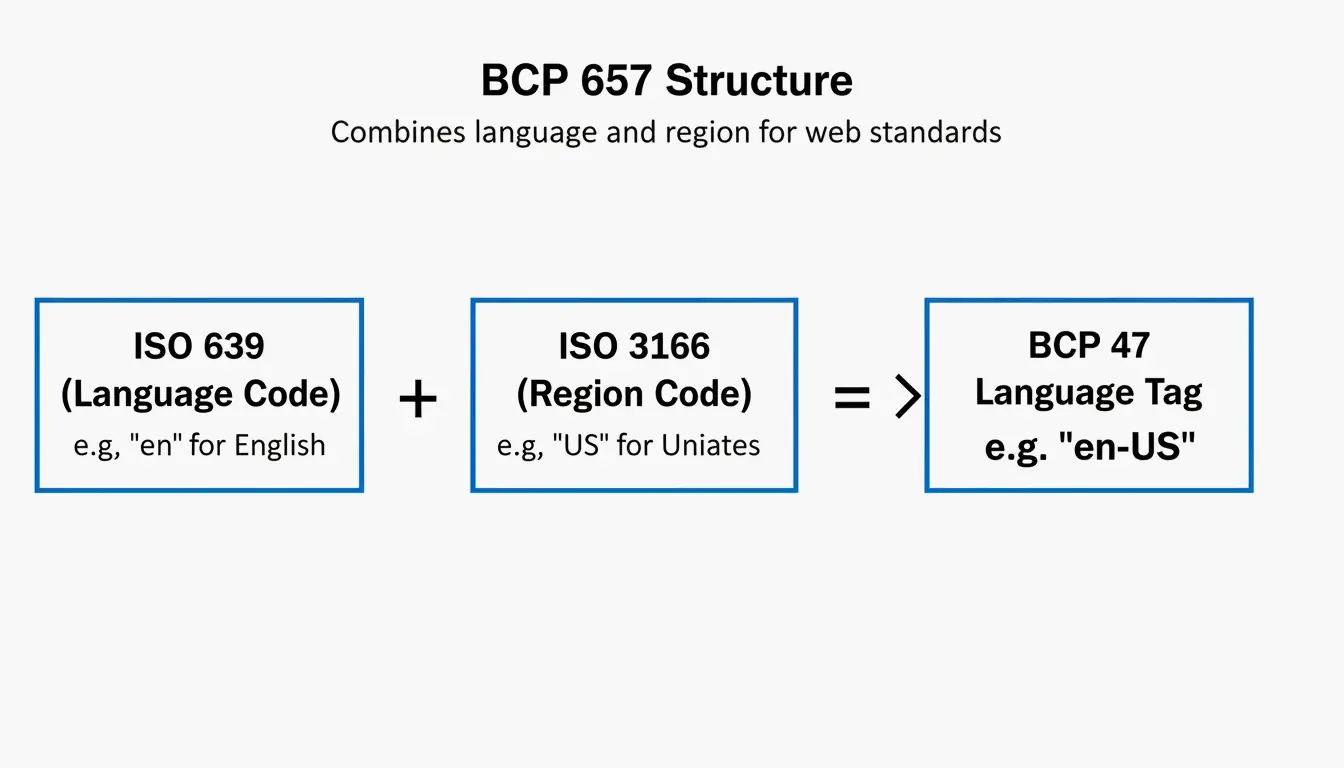
    Every locale tag combines two ISO codes:

    Component Standard Example Meaning
    Language ISO 639 en, ja, zh Language identifier
    Region ISO 3166 US, GB, JP Country/territory
    Script (optional) ISO 15924 Hant, Hans Writing system
    Variant (optional) IANA valencia Dialect or variant

    Full tag example: zh-Hant-TW = Chinese + Traditional script + Taiwan

    According to Java Documentation, a Locale object is a “mechanism for identifying objects” — not a container for data itself.

    BCP 47 language tag structure breakdown

    Language Tag Matching (RFC 4647)

    Method Behavior Use Case
    Filtering Returns all matching tags Content negotiation
    Lookup Returns single best match User preference fallback

    How Locale Changes Date, Number, and Currency Formats

    Locale Date Format Number Format Currency
    en-US MM/DD/YYYY 1,234.56 $1,234.56
    en-GB DD/MM/YYYY 1,234.56 £1,234.56
    de-DE DD.MM.YYYY 1.234,56 1.234,56 €
    ja-JP YYYY/MM/DD 1,234 ¥1,234
    zh-Hans-CN YYYY-MM-DD 1,234.56 ¥1,234.56

    Unicode Locale Extensions

    Advanced locale tags use u- extensions for granular control:

    Extension Example Effect
    u-ca-japanese en-US-u-ca-japanese Japanese Imperial calendar
    u-nu-thai th-TH-u-nu-thai Thai digit rendering
    u-cf-standard en-US-u-cf-standard Standard currency format

    Without BCP 47 compliance, systems may confuse zh-Hant (Traditional Chinese) with zh-Hans (Simplified Chinese), producing unreadable content.

    Currency Conversion: Mid-Market Exchange Rate

    When locale conversion handles money, accuracy depends on the exchange rate source.

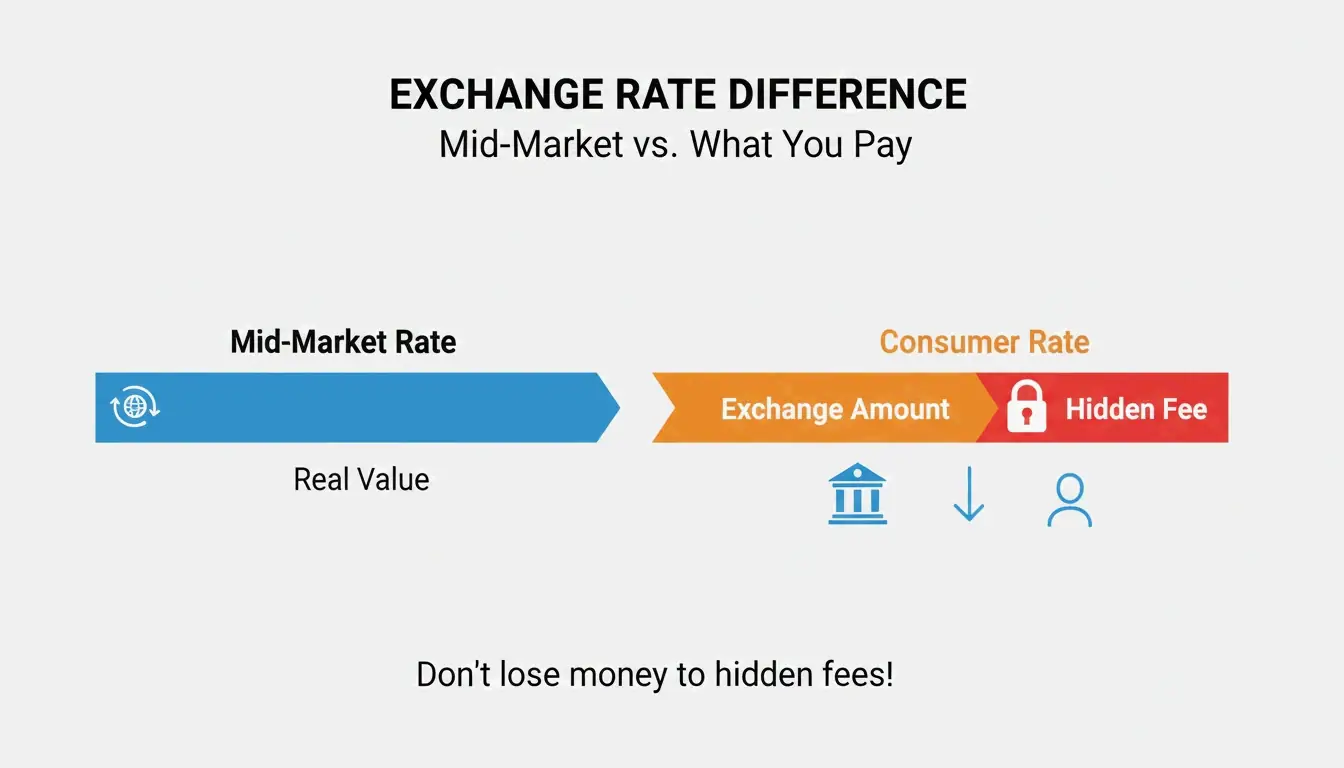
    Rate Type What It Is Who Gets It
    Mid-market rate Midpoint between buy/sell prices Interbank traders
    Consumer rate Mid-market + hidden markup Most individuals and businesses

    Wise emphasizes using the mid-market rate for transparency. OANDA tracks 31+ years of data across 38,000+ currency pairs for enterprise accuracy.

    Mid-market rate vs consumer rate comparison

    Developer Tools: Java Locale and BCP 47

    // Convert Java Locale to BCP 47 tag
    Locale locale = Locale.US;
    String tag = locale.toLanguageTag(); // Returns "en-US"
    
    // Create Locale from BCP 47 tag
    Locale fromTag = Locale.forLanguageTag("zh-Hant-TW");
    

    Java Documentation requires toLanguageTag() for modern web API compatibility.

    Enterprise Localization: Translation and Privacy

    PII Anonymization

    When creating localized test datasets, businesses must protect Personally Identifiable Information (PII). Tools like those shared by Rekhu Chinnarathod automatically mask Social Security numbers, credit card details, and other sensitive data — ensuring GDPR, HIPAA, and DPDP compliance.

    Prompt-to-Dataset Generation

    Rekhu Chinnarathod demonstrates AI tools that generate structured multi-locale datasets (JSON, CSV, SQL) from plain English descriptions, automatically respecting regional formats for US, UK, and India.

    Community Impact

    Queens Public Library uses LanguageLine to offer interpretation in 190+ languages, connecting residents with services in their preferred locale.

    Conclusion

    A locale converter does three things: standardize language tags via BCP 47, format data (dates, numbers, currency) by region, and enable accurate currency conversion using mid-market rates. For developers, integrate BCP 47-compliant APIs. For business users, always verify your converter uses the mid-market exchange rate.

    FAQ

    What is the difference between a language tag and a locale?

    A language tag (e.g., en) identifies only the language. A locale (e.g., en-US) adds regional rules for formatting dates, currency symbols, and cultural preferences specific to a country.

    How do I convert a Java Locale to a BCP 47 tag?

    Use Locale.toLanguageTag() — it converts the Locale object into an IETF BCP 47-compliant string. For reverse conversion, use Locale.forLanguageTag("en-US").

    Why do different currency converters show different rates?

    Some tools show the mid-market rate (transparent), while others embed a hidden markup. Rate freshness and data source (OANDA vs. a specific bank) also cause variation. Always check if your converter uses the mid-market rate as the baseline.