Category: Story

  • Days Until Christmas 2026: Exact Count and How to Check Today’s Number

    Days Until Christmas 2026: Exact Count and How to Check Today’s Number

    Header: Christmas countdown theme

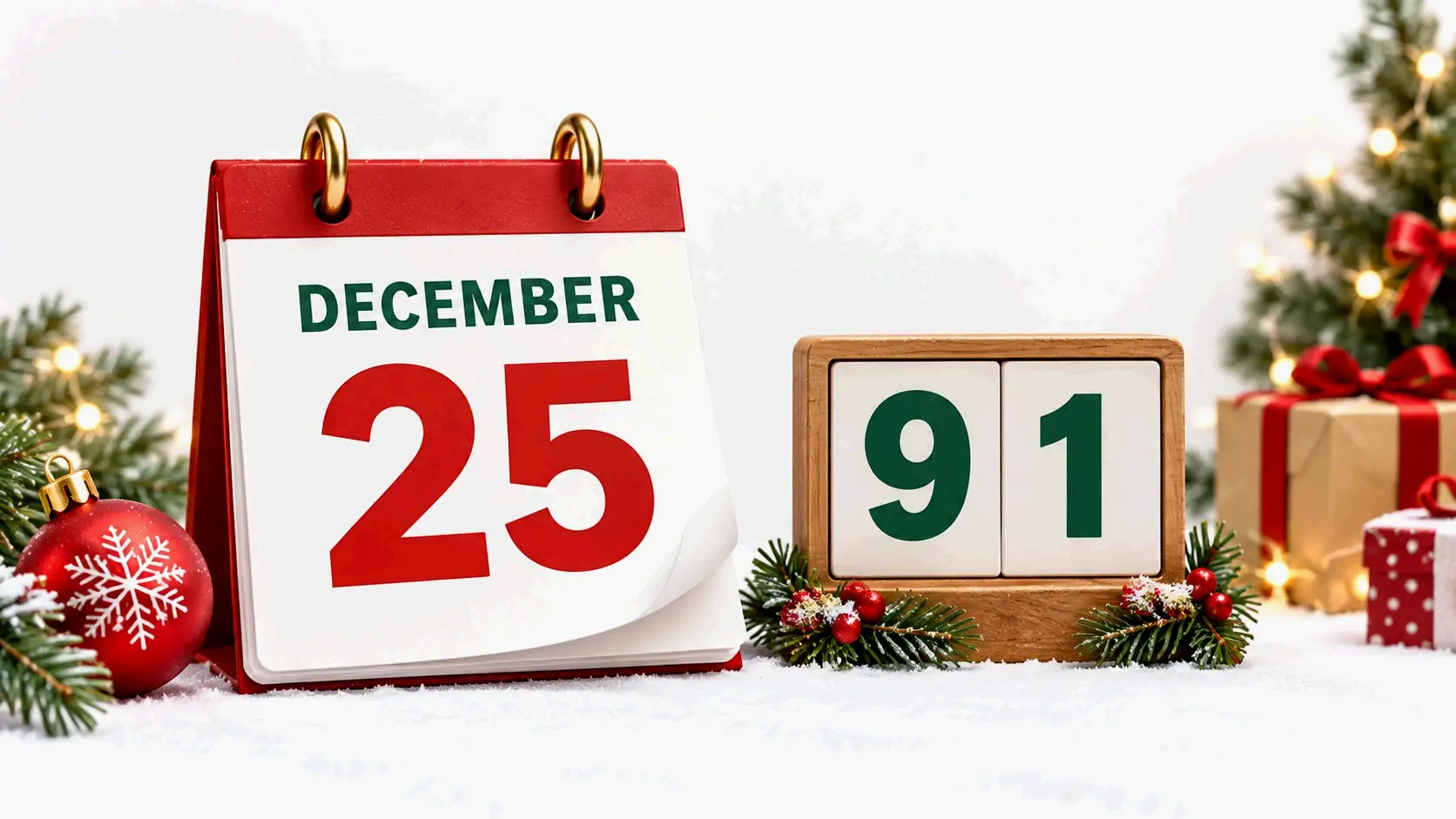
    As of September 25, 2026, there are 91 days until Christmas 2026. Christmas Day falls on Friday, December 25, 2026 — that’s 13 weeks, 13 weekends, or 91 sleeps. A live countdown timer shows 90 full days plus about 12 hours. And because every countdown number on this page drops by one each day, use this table to read the count for the date you’re actually on:

    If today is… Days until Christmas 2026
    October 9, 2026 77
    November 1, 2026 54
    November 26 (Thanksgiving) 29
    November 29 (Advent Sunday) 26
    December 1, 2026 24
    December 15, 2026 10
    December 24 (Christmas Eve) 1
    December 25 (Christmas Day) 0

    The convention throughout: today is not counted, Christmas Day is. Every row follows the same rule the article unpacks below — and the spreadsheet formula near the end gives you a number that updates itself daily.

    How Many Days Until Christmas 2026? The Direct Answer

    There are 91 days until Christmas Day 2026, which falls on Friday, December 25, 2026. Days.To breaks the same wait down as 13 weeks, 13 weekends, 64 weekdays, 2,184 hours, and 91 sleeps.

    Quick answer: 91 days, 13 weeks, 91 sleeps

    How Many Days Until Christmas reports 91 calendar days from September 25, 2026 in New York, or exactly 13 weeks and 0 days. Inch Calculator also lands on 91 days, or 13 weeks and 2,184 hours, and notes that Christmas is a U.S. federal holiday.

    As-of date and timezone: America/New_York

    Every number on this page is tied to an as-of date of September 25, 2026 and to the America/New_York timezone. That phrase — “as of September 25, 2026 in New York, there are 91 calendar days” — matters because the count drops by one each day. Inch Calculator shows 95 days on September 21, 94 on September 22, 93 on September 23, 92 on September 24, and 90 on September 26. If you read this on a later date, expect a smaller number.

    Why Your Live Christmas Countdown Timer Shows 90 Days, Not 91

    The 90-versus-91 gap isn’t an error. It comes from two different ways of measuring the same stretch of time: calendar date labels and complete 24-hour periods.

    A calendar-day count leaves out today, September 25, and includes December 25. That gives you 91 days. A live timer measures full 24-hour blocks left until midnight starts Christmas Day, so it shows 90 full days plus a partial day. Days.To displays both on one page — a timer reading 90d:12h:10m:26s next to a written answer of “91 days until Christmas Day.” That side-by-side display is the most common source of confusion. How Many Days Until Christmas explains the same split in its FAQ: one display counts New York date changes, the other counts complete 24-hour cycles, and a partial day can push the full-day figure down by one.

    Calendar days vs. 24-hour periods: the rule to remember

    Use calendar days when you want a date-to-date answer: September 25 to December 25 is 91 days. Use the live timer when you want the exact time remaining: roughly 90 days and 12 hours from the moment the timer was read. Neither is wrong. They answer slightly different questions.

    Which number should you quote?

    Quote 91 days for conversations, planning, and headlines tied to a date. Quote “90 days plus about 12 hours” only when someone wants precision down to the current hour. If a friend insists the real answer is 90, they are reading a live timer, not a calendar.
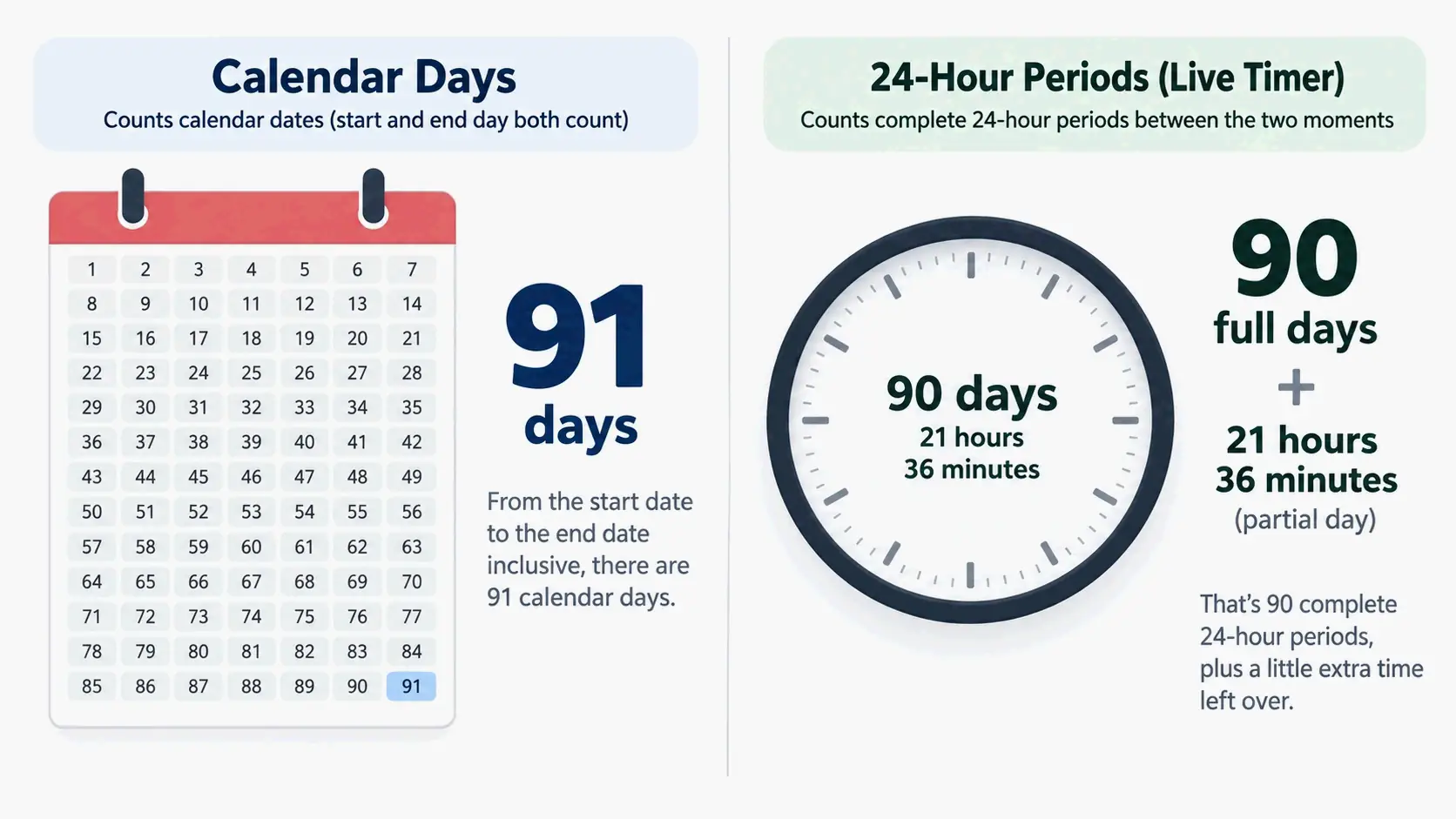
    Concept: 91 calendar days vs. 90 days + 12 hours

    91 Days in Other Units: 13 Weeks, 13 Weekends, and 91 Sleeps

    The same 91 days can be broken into a few useful units. Each one suits a different planning purpose.

    Weeks, weekends, and sleeps

    How Many Days Until Christmas gives 13 weeks and 0 days, 13 weekends, and 91 sleeps. Days.To agrees on 13 weeks, 13 weekends, and 91 sleeps, and adds 2,184 hours. Your Christmas Countdown explains the sleep convention plainly: add 1 to the number of days shown, and that is how many sleeps remain. Sleeps are the version most families and classrooms use, because each night marks one visible step toward Christmas morning.

    Hours and minutes (if you really want precision)

    Two sources report slightly different hour totals — 2,184 from Days.To and Inch Calculator, versus 2,177 from How Many Days Until Christmas — because each page measures from the moment it was loaded. Treat any hour or minute figure as a snapshot, not a fixed fact. Re-check it if you need the number for a specific moment.

    Shopping days and business days

    How Many Days Until Christmas counts 90 potential shopping dates after September 25 through Christmas Eve, December 24, 2026 — noting that this does not check store hours, holidays, stock, or delivery cut-offs. One older convention is worth retiring: skipping Sundays as shopping days predates online carts and Sunday trading, as FailFlow points out. Workday counts get their own section below, because sources disagree.

    Christmas Day 2026 Falls on Friday: What It Means for Christmas Eve and Boxing Day

    Christmas Day 2026 is Friday, December 25, 2026. That puts Christmas Eve on Thursday, December 24, and Boxing Day on Saturday, December 26.

    The 2026 Christmas week at a glance

    How Many Days Until Christmas lists the surrounding U.S.-relevant dates for 2026: Thanksgiving on Thursday, November 26; the First Sunday of Advent on November 29; Christmas Eve on Thursday, December 24; Christmas Day on Friday, December 25; Boxing Day on Saturday, December 26; New Year’s Eve on Thursday, December 31; and New Year’s Day on Friday, January 1, 2027.
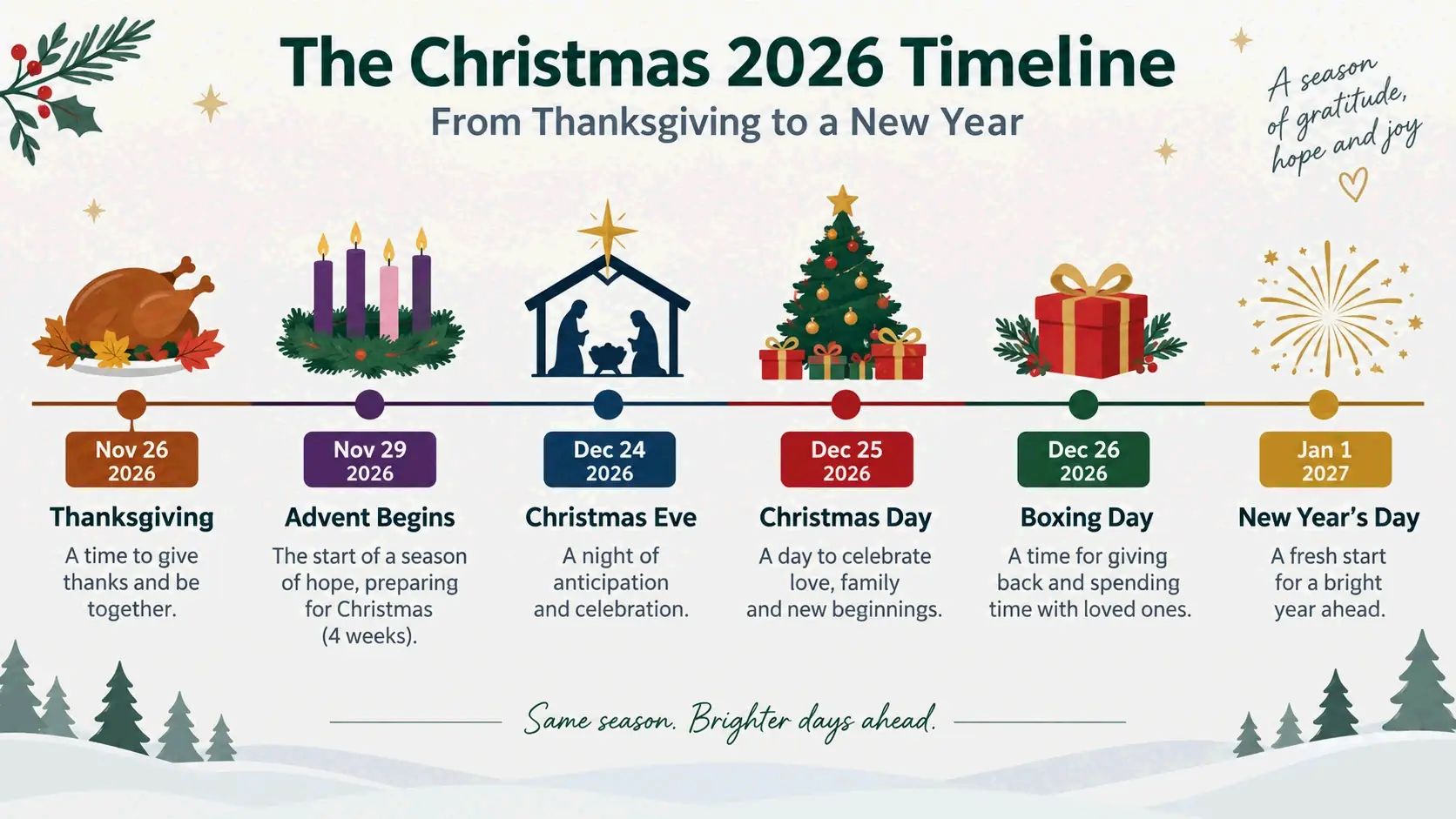
    Timeline: key dates around Christmas 2026

    Boxing Day is not a U.S. federal holiday. WatchIsUp notes that December 26 is a holiday in the UK, Ireland, Canada, Australia, and New Zealand, but in the United States it is an ordinary working day, so many businesses stay open. Christmas Day itself is a U.S. federal holiday, according to Inch Calculator.

    Is Christmas 2026 a long weekend?

    Whether a Friday Christmas creates a long weekend depends on your employer, your state, and applicable holiday rules. How Many Days Until Christmas states it directly: Thursday and Monday are not automatically days off, so check school calendars, opening hours, and travel availability before booking anything.

    One pattern to remember: the same source’s Christmas Day-of-Week History table shows 2024 on Wednesday, 2025 on Thursday, 2026 on Friday, 2027 on Saturday, 2028 on Monday, 2029 on Tuesday, and 2030 on Wednesday.

    Weekdays and Business Days Until Christmas 2026

    Workday counts for the same 91-day window differ by one depending on the source and the counting convention.

    Days.To reports 64 weekdays (Monday to Friday) until Christmas Day, not counting the day itself. Inch Calculator reports 65 weekdays and warns that its figure does not account for holidays falling on weekdays, such as Thanksgiving. FailFlow also lands on 65 business days counting weekdays only, with public holidays not subtracted.

    How weekdays are counted

    The typical method counts Monday-through-Friday dates between today and the target date. September 25, 2026 falls on a Friday, so the count includes every remaining weekday in September, all of October and November, and the December weekdays before Christmas — except for the holiday adjustments each source chooses to apply or ignore.

    Why 64 vs 65 matters

    Christmas Day is a U.S. federal holiday, so a business-day calculation can legitimately exclude December 25 as a non-working day. That is why the totals sit one apart. For office planning, commutes, and deadline-setting, use 64 weekdays as the conservative figure and subtract any additional company holidays you observe.
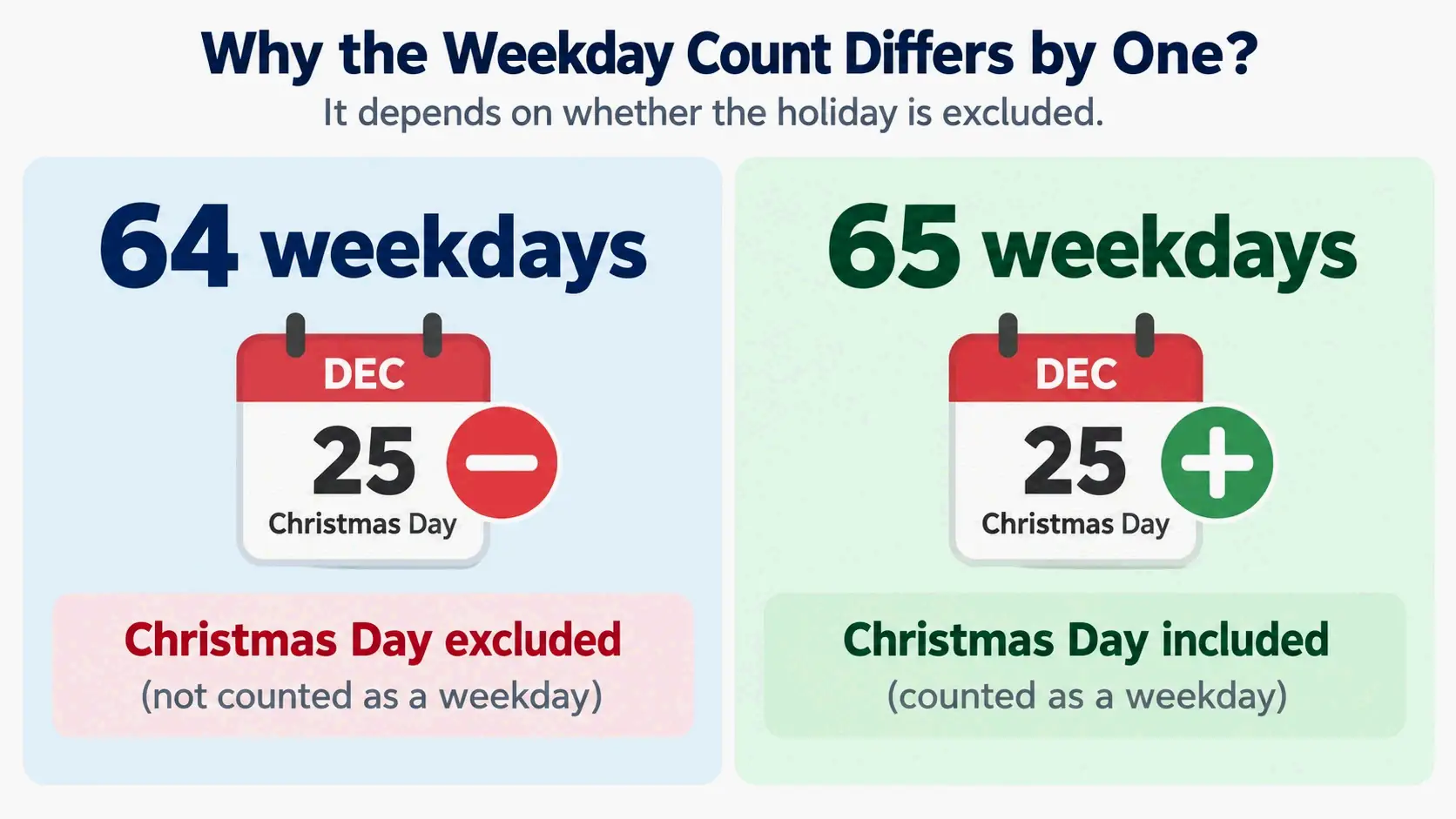
    Comparison: 64 vs 65 weekdays and the holiday exclusion

    Advent 2026 and US Thanksgiving: Your Next Countdown Anchors

    Ninety-one days is too long to hold in your head. Two late-November anchors — Thanksgiving and Advent — break the wait into manageable phases.

    Thanksgiving 2026 countdown

    US Thanksgiving is Thursday, November 26, 2026. How Many Days Until Christmas places it in the 2026 key-dates list as the unofficial start of the American Christmas season. Days.To listed 62 days to Thanksgiving when its Christmas page was captured on September 25, 2026. That gives you roughly two months from the as-of date to plan menus, travel, and early decorating.

    Advent 2026: November 29 vs December 1

    In Western Christian calendars, Advent 2026 begins on Sunday, November 29, 2026, according to How Many Days Until Christmas, which also records Advent at 65 days out from September 25. WatchIsUp adds the seasonal range: Advent counts the four Sundays before Christmas, so it starts between November 27 and December 3 each year. A chocolate Advent calendar is a different convention entirely — those always begin on December 1. Keep the two separate when you plan, or you will be four days off.

    From Countdown to Action: A US Christmas Planning Timeline

    With 91 days and roughly 90 potential shopping dates through December 24, the practical move is to split the countdown at U.S. holiday anchors rather than treat it as one long block.

    November: Thanksgiving and Advent kickoff

    Thanksgiving on November 26 and Advent on November 29 sit four days apart in 2026, so late November is your natural planning checkpoint. Use the days before them to agree on budget, recipients, and likely guests, and to verify long-lead items — custom orders, travel bookings, and shared family dates — because those decisions need the most lead time. How Many Days Until Christmas frames this as a flexible sequence: set limits, check long-lead plans, choose details, confirm final arrangements, and leave room for changes.

    December: shopping, shipping, and Christmas Eve

    December holds the compressed work. Days.To counts 64 weekdays for planning, and Christmas Eve lands on Thursday, December 24 — one day before the holiday. FailFlow notes that Christmas Eve comes 90 days after September 25, 2026, and that all 91 days count as shopping days under modern retail conditions. Work backward from December 24 for gifts that must ship, and treat the last week as buffer rather than primary shopping time.
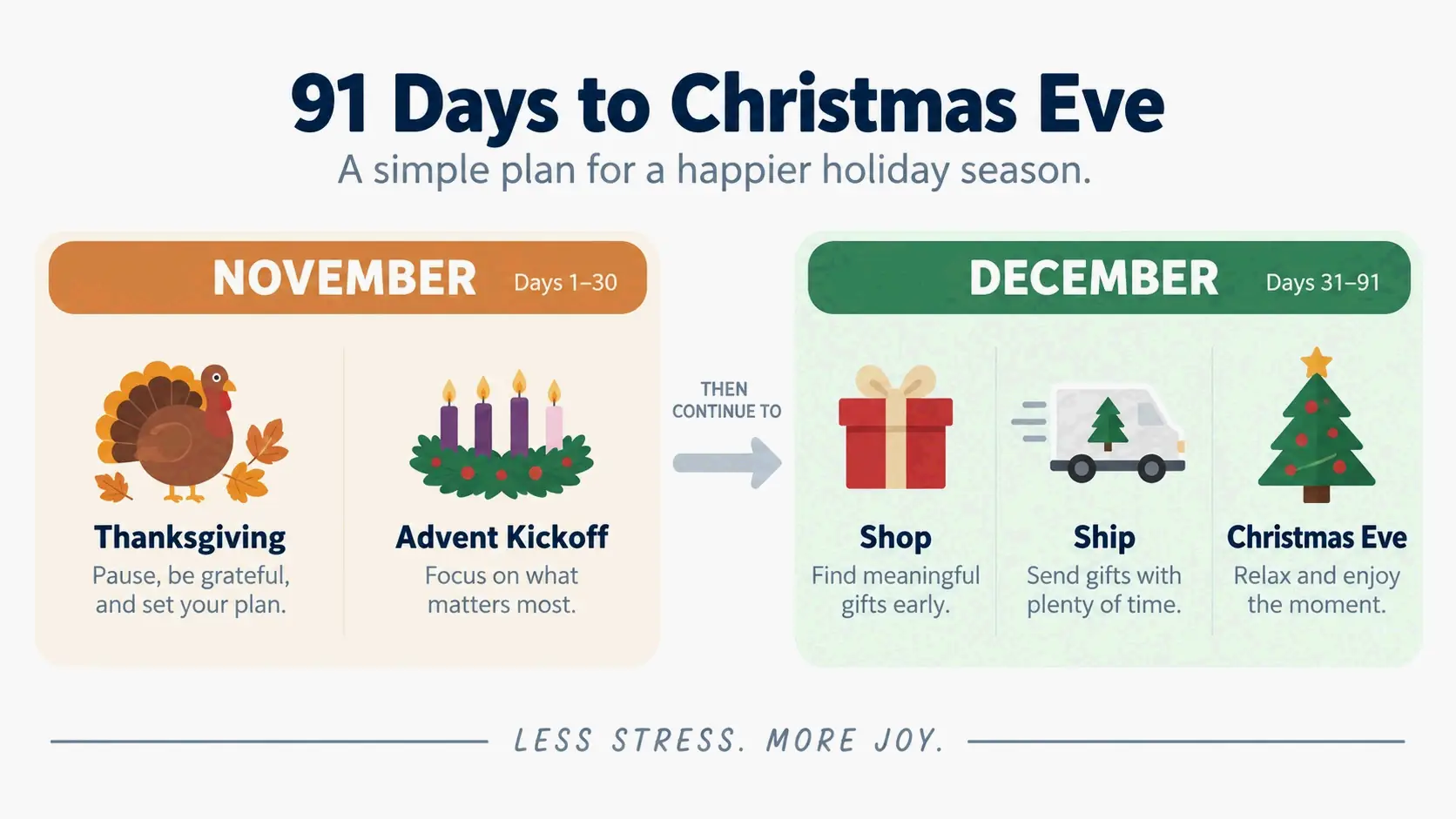
    Planning timeline: November and December phases

    What to verify instead of copying dated shipping deadlines

    Carrier deadlines are the least reusable content in Christmas planning. Countdown Christmas publishes Royal Mail and Parcelforce posting dates tied to UK addresses and a specific year — a useful illustration of why any deadline table you find may be both out of date and in the wrong country. Instead, check the official carrier page for the year and destination you are shipping to, and confirm processing times, stock, delivery estimates, and return terms before paying. Finally, remember that countdown answers expire daily: always match a number to its as-of statement.

    How to Calculate Days Until Christmas 2026 Yourself (Google Sheets / Excel)

    If you want a number you control, a spreadsheet handles it in one cell — and the same calendar-day conventions (exclude today, include the target) are exactly the rules covered in how many days between two dates, applied to a fixed destination.

    Basic days formula

    Type =DATE(2026,12,25)-TODAY() into any cell and press Enter. Inch Calculator documents this formula and a variant for a fixed start date in another cell: =DATE(2026,12,25)-A1. The result updates automatically as TODAY() moves forward.

    Weeks and business days formulas

    For whole weeks, use =INT((DATE(2026,12,25)-TODAY())/7), the method Inch Calculator lists for weeks until Christmas. For workdays, the standard =NETWORKDAYS(TODAY(), DATE(2026,12,25)) counts Monday through Friday but does not subtract holidays, so add a holiday range or edit the result manually — Thanksgiving and Christmas Day both fall on weekdays in 2026. Set the spreadsheet timezone to America/New_York so your count matches the countdown pages referenced here.

    Classroom Countdown Ideas: 91 Sleeps and 64 Weekdays

    Countdown numbers work well in classrooms because they are visual, finite, and easy to update each morning.

    Paper chain and daily countdown

    How Many Days Until Christmas describes the classic approach: make one paper chain loop for every remaining sleep, then remove one after waking each day. With 91 sleeps as of September 25, 2026, a full chain is long enough to fill a wall and visibly shrink. Teachers tracking working days only can use the 64-weekday figure instead, which fits a classroom calendar better than calendar days.

    Advent calendar vs. Advent Sunday in the classroom

    Advent 2026 begins Sunday, November 29, and a numbered December calendar starts December 1 — four days apart. Label which one your class is following, or the count will look wrong to students. Optional add-ons mentioned by countdown sites include watching one Christmas film a week from mid-November and using an Elf on the Shelf routine, which Your Christmas Countdown links to as a family and classroom activity.

    2026 Christmas News and Entertainment Updates

    Updated September 2026. The items below are the entertainment stories countdown trackers were covering in late September 2026. They are listed with their reporting dates rather than treated as confirmed schedules.

    Your Christmas Countdown reported that Mariah Carey is bringing her Christmas show to the UK in 2026, that Tyler Perry’s The Gospel of Christmas is coming to Netflix in 2026, and that its Christmas Movies 2026 roundup of confirmed films was updated in September 2026. Treat announcements as announcements: verify release dates on the platform or ticketing page before planning around them, and expect titles without a firm date to shift.

    Conclusion

    As of September 25, 2026, there are 91 days until Christmas 2026, and Christmas Day lands on Friday, December 25, 2026. Pick one anchor rather than tracking all 91 days: US Thanksgiving on November 26, Advent on November 29, or a December shopping milestone that forces early decisions. Use the live countdown for daily motivation, but check any number against its as-of date and timezone, because every countdown answer on this page drops by one tomorrow.

    FAQ

    Does the Christmas countdown include today?

    No. The standard calendar-day count leaves out today and includes Christmas Day. That is why the answer as of September 25, 2026 is 91 days. How Many Days Until Christmas shows the same convention in action, displaying 1 on Christmas Eve and 0 throughout Christmas Day. Including today would give 92, but most countdowns do not count the current day.

    Why does the live timer show 90 days when the calendar says 91 days?

    The calendar answer counts date labels: September 25 to December 25 spans 91 days. A live timer measures full 24-hour periods, so it shows 90 full days plus about 12 hours. Days.To displays both a 90d:12h timer and the written answer “91 days” on the same page, which is exactly where the confusion starts.

    How many sleeps until Christmas 2026 for kids?

    There are 91 sleeps until Christmas 2026 as of September 25, 2026, according to both Days.To and How Many Days Until Christmas. Sleeps are a family-friendly count because each night marks one step closer to Christmas morning. Naps do not reduce the total, and the number drops by one each morning after waking.

    When does Advent start in 2026?

    In Western Christian calendars, Advent 2026 begins on Sunday, November 29, 2026, per How Many Days Until Christmas. An Advent calendar with numbered doors usually starts December 1, a different convention. WatchIsUp confirms the range: Advent begins between November 27 and December 3 depending on the year.

    What day of the week is Christmas 2026, and does that create a long weekend?

    Christmas Day 2026 is Friday, December 25, 2026, with Christmas Eve on Thursday and Boxing Day on Saturday. Whether that becomes a long weekend depends on your employer, state, and federal holiday rules. How Many Days Until Christmas warns that Thursday and Monday are not automatically days off.

    How many shopping days or business days are left until Christmas 2026?

    How Many Days Until Christmas counts about 90 potential shopping dates through December 24, 2026. Business-day totals vary: Days.To reports 64 weekdays, while Inch Calculator reports 65, a difference driven by whether Christmas Day is excluded as a federal holiday.

    Is Christmas always on December 25?

    For most Western Christian traditions, Christmas is observed on December 25, and 2026 is no exception. The date is not universal: How Many Days Until Christmas notes that churches using the Julian calendar currently observe Christmas on January 7 in the Gregorian calendar. Other traditions follow their own calendar practices for gift-giving and observance.

    When is Christmas 2027?

    Christmas Day 2027 falls on Saturday, December 25, 2027, one day later in the week than 2026. Days.To listed it as 456 days away when its Christmas page was captured on September 25, 2026. That 456 is simply the 91 days to Christmas 2026 plus the 365 days of 2027 — and because 365 is 52 weeks plus 1 day, the weekday slides one slot each year.
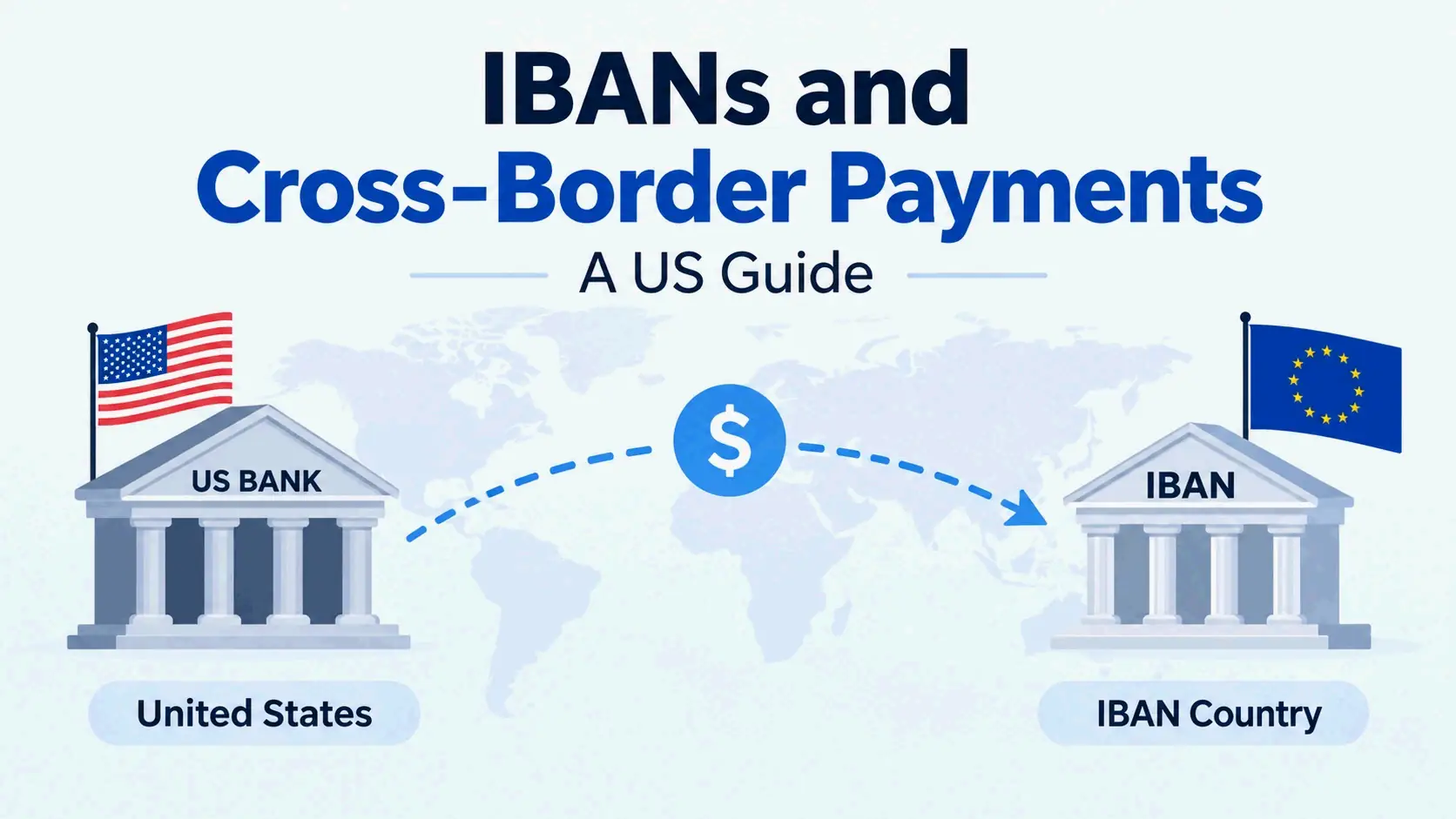
  • What Is an IBAN Number? A US Guide to IBANs and SWIFT

    What Is an IBAN Number? A US Guide to IBANs and SWIFT

    Header: IBAN and US cross-border payment essentials

    An IBAN (International Bank Account Number) is a standardized code of up to 34 characters that identifies a specific bank account for cross-border payments. It combines a two-letter country code, two check digits, and a country-specific BBAN. US banks do not issue IBANs, so US senders and recipients use a routing number plus the bank’s SWIFT/BIC code instead.

    What Is an IBAN Number? Definition, Scope, and Limits

    An IBAN is an internationally agreed way to identify bank accounts across national borders. The goal is to reduce transcription errors and let banks in different countries process cross-border transactions using one consistent format, instead of a patchwork of national account-numbering schemes. An IBAN points to one customer’s account at a financial institution; it is not a generic bank address or a payment network.

    The standard behind it is ISO 13616. According to Wikipedia’s overview of the International Bank Account Number, the format was originally adopted by the European Committee for Banking Standards (ECBS) and has been published as the international standard ISO 13616 since 1997. The current version is ISO 13616:2020, which names SWIFT (the Society for Worldwide Interbank Financial Telecommunication) as the formal registrar.

    The 30-Second Definition

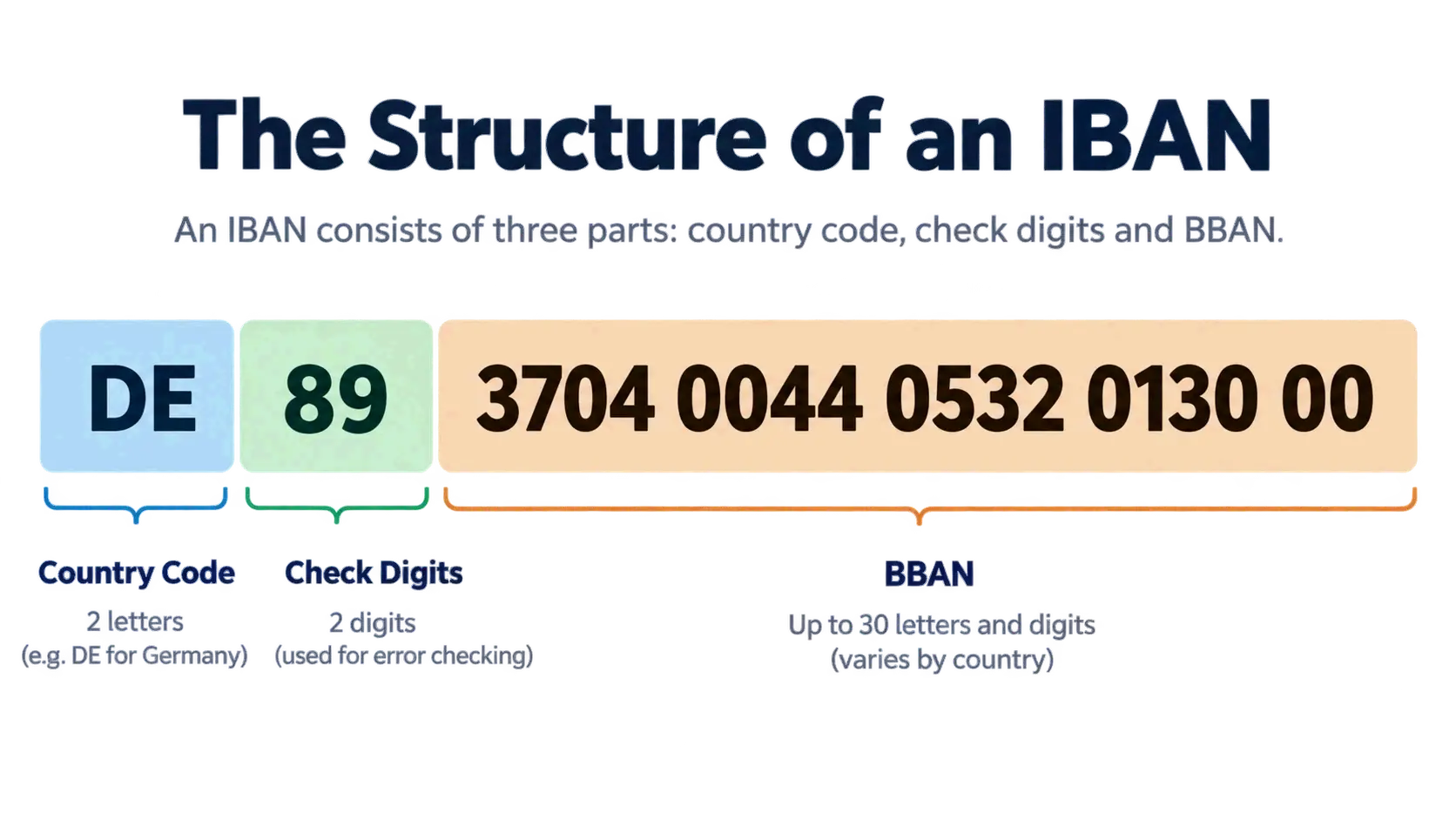
    An IBAN is a string of up to 34 alphanumeric characters made of three parts: a two-letter country code, two check digits, and a country-specific Basic Bank Account Number (BBAN) that holds the domestic bank code, branch identifier, and account number. Banks validate the check digits before releasing a payment, which catches most single-character typos at the point of data entry. In practice, an IBAN answers one question: which exact account, at which bank, in which country.

    What an IBAN Is Not

    An IBAN is not a bank identifier. A bank identifier — the SWIFT/BIC code — points to an institution or branch, while an IBAN points to a specific account inside that institution. International wires commonly require both.

    An IBAN is also not a payment network. SWIFT, SEPA, ACH, Fedwire, and card networks move or message money; an IBAN is only an addressing standard that those systems read.

    Finally, an IBAN is not a US routing number. A routing number is a nine-digit domestic code, and it is not accepted as an IBAN substitute in any IBAN country. As Ramp’s guide to IBAN numbers puts it, if a form asks you for a US IBAN, there simply isn’t one to provide.

    The practical boundary for US readers is simple: US banks do not issue IBANs, which is why the rest of this guide focuses on what US senders and recipients actually put on a payment form.

    Do US Banks Issue IBANs? What to Use Instead

    No. US banks do not issue IBANs, and US accounts are not assigned one when opened. The United States relies on ABA routing transit numbers for domestic account identification, and on SWIFT codes for international routing. Any adoption of the IBAN standard by US banks would likely be initiated by ANSI ASC X9, the US financial services standards development organization — a working group (X9B20) was established as an X9 subcommittee to generate an IBAN construction for US bank accounts, but nothing has replaced routing numbers in practice.

    The US substitute is a three-part package: a nine-digit ABA routing number, the account number, and the bank’s SWIFT/BIC code whenever the payment crosses a border.

    Domestic rails explain why the US never needed IBANs. ACH, Fedwire, FedNow, and RTP all operate inside a single national numbering system, so nine-digit routing numbers plus account numbers are sufficient for the vast majority of US payments. SEPA Instant plays an equivalent same-country role in the euro area, but it sits on top of IBAN-based accounts.

    What to Put on an International Payment Form as a US Sender

    When a US bank’s wire form asks for beneficiary details, use the recipient’s local fields, not US ones. The typical field-by-field entries look like this:

    • Beneficiary IBAN or account number: enter the full IBAN for the recipient’s country, exactly as provided, with no spaces and no edits to the check digits.
    • Beneficiary bank SWIFT/BIC: the 8- or 11-character code identifying the recipient’s bank.
    • Beneficiary name and address: exactly as the account is registered.
    • Your routing number and account number: these identify your own US account as the source of funds, not the recipient.
    • Intermediary bank details: requested when your bank has no direct relationship with the recipient’s bank.

    If a form asks for a “US IBAN” on your side, there is nothing to enter; your routing number and account number serve that role.

    What to Give a Foreign Payer as a US Recipient

    A foreign payer sending money into a US account needs four details: your bank’s nine-digit ABA routing number, your account number, your bank’s SWIFT/BIC code, and the account holder name as registered.

    Multi-currency providers such as Wise and Revolut can assign IBANs to eligible accounts precisely so international payers have a single validated identifier to use. If you hold an account with one of those providers and it has been issued an IBAN, share that IBAN instead of domestic details. If you bank with a traditional US institution, share the routing number, account number, and SWIFT/BIC combination.

    One timing detail matters on the receiving end: funds arriving in a foreign currency are converted at the prevailing exchange rate before they reach your account, so the number on the invoice is not necessarily the number that lands.

    How an IBAN Is Structured: Country Code, Check Digits, and BBAN

    Every IBAN follows the same three-part sequence, and every part has a fixed job.

    The country code occupies the first two characters and uses ISO 3166-1 alpha-2 — DE for Germany, FR for France, GB for the United Kingdom. The country code determines which BBAN format applies, so it is the first thing a validating system checks.

    The check digits occupy positions three and four. They are calculated from the rest of the string and validated with the MOD-97 checksum described in ISO 7064, letting a bank confirm the number contains no simple transcription error before submitting a transaction.

    The BBAN fills every remaining character, up to a maximum of 30 alphanumeric characters. It carries the domestic bank code, branch identifier, and account number in whatever national format the country uses. The national central bank or designated payment authority decides that format, which is why BBAN structures are not consistent between countries.

    IBAN three-part structure: country code, check digits, BBAN

    Real IBAN Examples by Country

    The following examples come from Ramp’s IBAN guide and are illustrative formats rather than live accounts:

    Country Country Code Total Length Sample Format
    Norway NO 15 NO93 8601 1117 947
    Belgium BE 16 BE68 5390 0754 7034
    Netherlands NL 18 NL91 ABNA 0417 1643 00
    Germany DE 22 DE89 3704 0044 0532 0130 00
    United Kingdom GB 22 GB29 NWBK 6016 1331 9268 19
    France FR 27 FR14 2004 1010 0505 0001 3M02 606
    Malta MT 31 MT84 MALT 0110 0012 3456 MTLC AST0 01S

    Reading the German example: DE is the country, 89 is the checksum, 37040044 is the bank identifier, and 0532013000 is the individual account number.

    Why IBAN Length Varies by Country

    Total IBAN length is fixed nationally, which is why it ranges from 15 characters in Norway to the 34-character ceiling. Norway uses 15, Belgium 16, the Netherlands 18, Germany and the UK 22, Spain 24, France and Italy 27, and Malta 31.

    Because each country’s BBAN encodes different elements — some include branch codes, some include national check digits, some include account-type indicators — the length cannot be standardized across borders. The IBAN registry is the official source for each country’s length and format, and validating systems check the total length against the country code before running the checksum.

    How IBAN Check Digits Work — and What They Don’t Verify

    The IBAN check digits use a MOD-97 operation, formally described in ISO 7064, to confirm that a string contains no simple errors. The validation is designed to catch single-character substitutions, nearly all single transpositions, and shifts of the whole string to the left or right.

    This matters because it moves error detection to the moment of data entry. A bank’s system can reject a mistyped IBAN immediately rather than discovering the problem days later when the payment bounces back through intermediary banks. That design goal — validating as much as possible at the point of entry — is the core reason IBANs reduced cross-border failure rates compared with the pre-1997 arrangement.

    A Worked MOD-97 Example

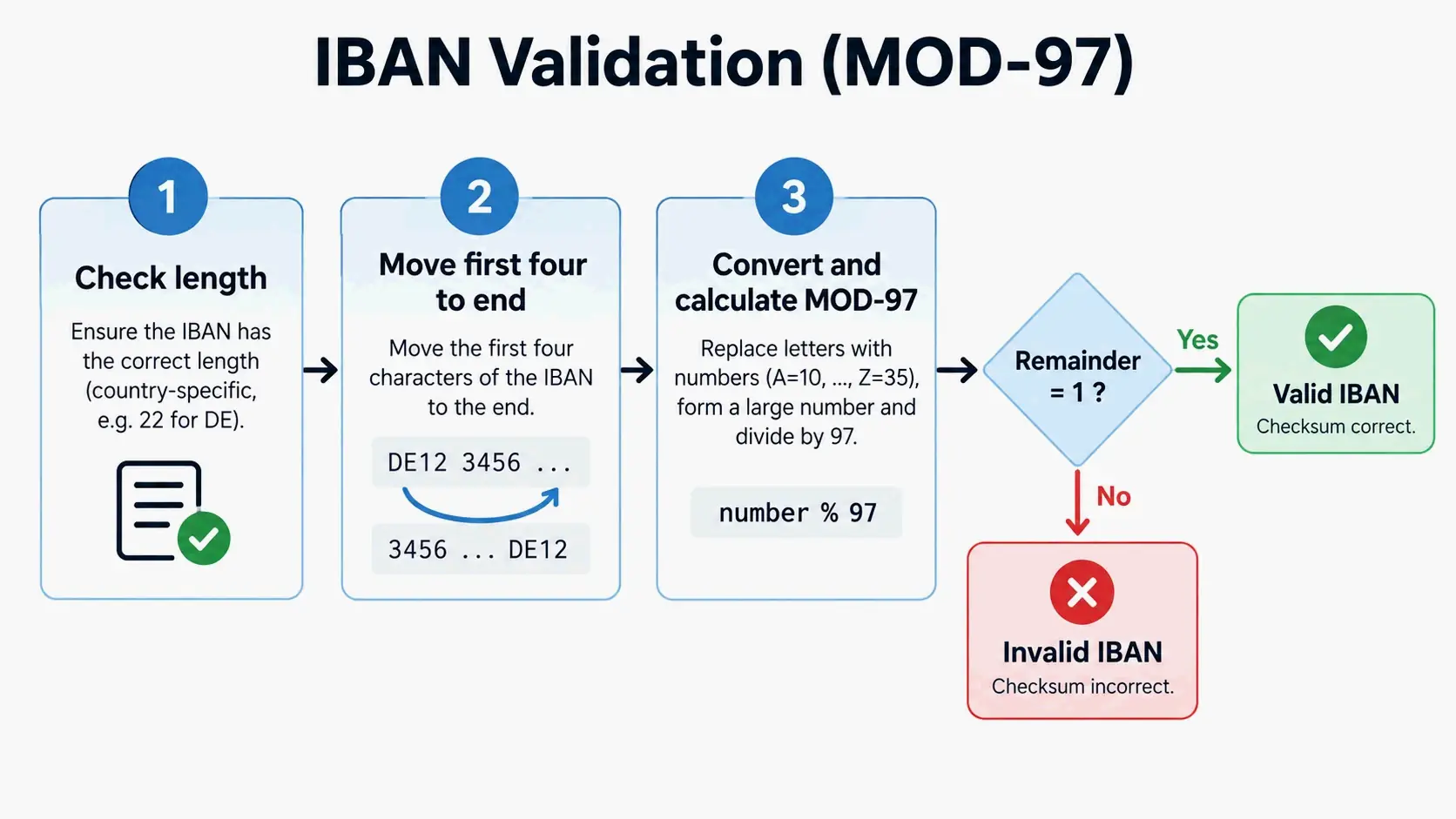
    The validation algorithm has four steps: confirm the total length matches the country, move the first four characters to the end, replace each letter with two digits (A = 10 through Z = 35), then divide the resulting integer by 97. If the remainder is 1, the check digit test passes.

    Simplified MOD-97 validation steps

    Using the fictitious United Kingdom example published on Wikipedia, IBAN GB82 WEST 1234 5698 7654 32:

    1. Rearrange: move GB82 to the end → WEST12345698765432GB82
    2. Convert letters to digits: W=32, E=14, S=28, T=29, then G=16, B=11 → 3214282912345698765432161182
    3. Compute the remainder: 3214282912345698765432161182 mod 97 = 1

    Because the remainder is 1, the string passes the check digit test.

    What the Checksum Does Not Check

    This is the limitation that costs people money. A checksum-valid IBAN confirms the string is correctly formatted; it says nothing about who owns the account. A wrong IBAN that happens to be mathematically valid will send funds to the wrong recipient.

    As Bertrand Théaud, Founder of Statrys, notes: “A correctly formatted IBAN is not proof the payment will land in the right account. For transfers outside the SEPA zone, the check digits catch typos, not wrong account numbers, so validate the account holder’s name yourself, not just the string of characters.”

    Inside SEPA, banks are now required to flag a clear name mismatch before sending, though a close-enough match can still pass. Outside SEPA, banks generally do not verify that the recipient’s name matches the account holder before crediting funds, so recovery is slow and not guaranteed. The practical rule is to verify the account holder’s identity independently — by confirming the beneficiary name through a channel you trust — in addition to checking the IBAN string.

    IBAN vs SWIFT/BIC vs Routing Number: Which Code Does What?

    Each code answers a different question, and mixing them up is one of the most common causes of delayed international payments.

    Criteria IBAN SWIFT/BIC Routing Number
    Purpose Identifies an individual account Identifies a bank or branch Identifies a US financial institution
    Length Up to 34 characters 8–11 characters 9 digits
    Geographic use Primarily Europe, Middle East, Caribbean Worldwide United States, domestic only
    Format Country code + check digits + BBAN Bank code + country code + location code + optional branch code Numeric

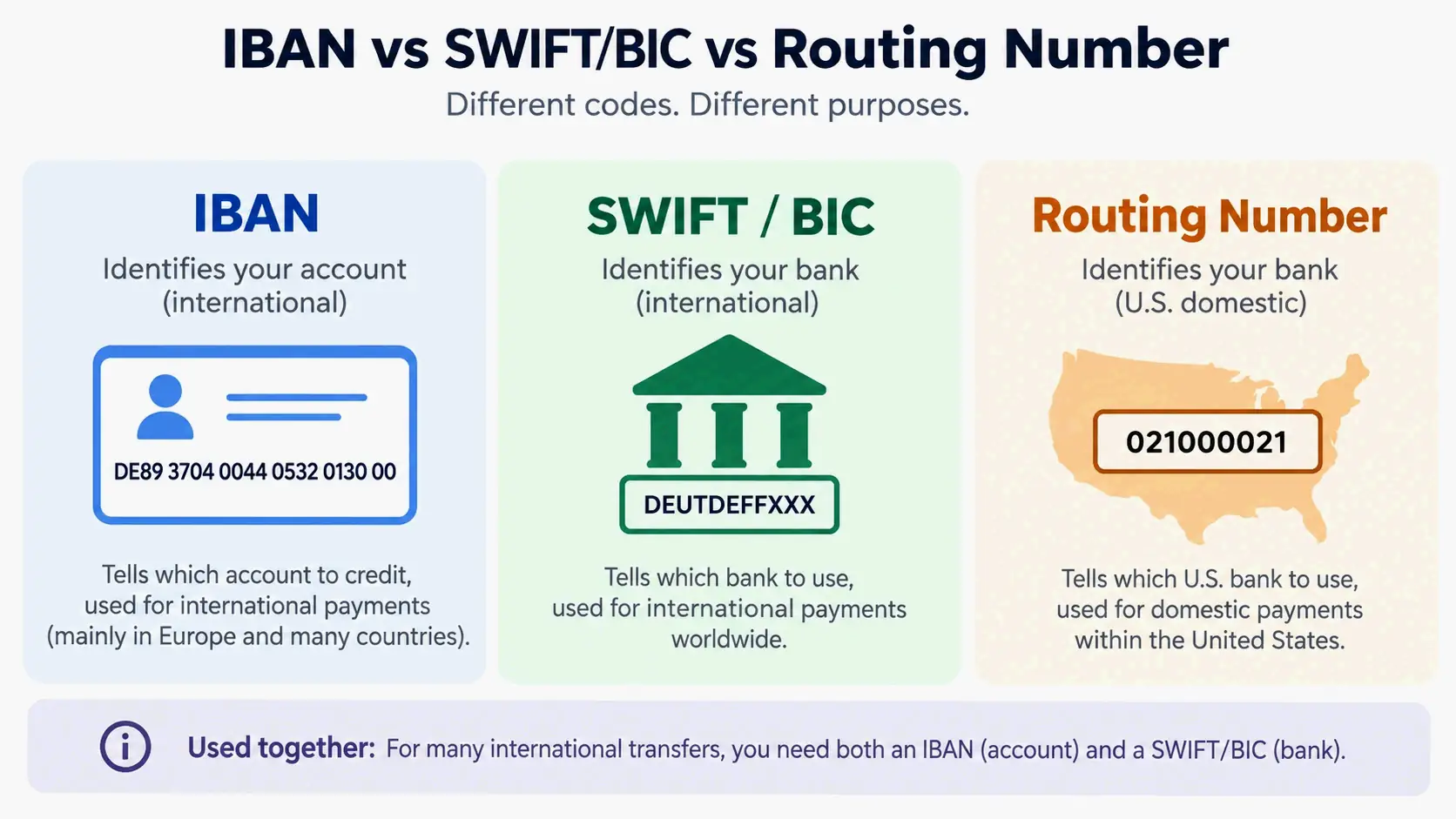
    An IBAN identifies the account. A SWIFT/BIC code identifies the institution. A routing number identifies a US bank inside the domestic network and never travels beyond it. An IBAN and a SWIFT/BIC code are frequently used together on international wires: the SWIFT code routes the payment to the right bank, and the IBAN directs it to the right account inside that bank.

    Three codes, three roles: account vs bank vs US domestic

    The scale of the SWIFT network explains why SWIFT/BIC codes remain essential even when an IBAN is present. Ramp notes that SWIFT is used by more than 11,000 financial institutions worldwide, and that the network extends beyond traditional banks to brokerage firms, payment processors, and other participants.

    When You Need Both an IBAN and a SWIFT Code

    You need both when the destination account sits in an IBAN country. A transfer from France to Germany requires the recipient’s IBAN and the recipient bank’s SWIFT/BIC. Within SEPA, an IBAN alone is often sufficient to identify an account, and banks are no longer permitted to require customers to supply the beneficiary bank’s BIC for SEPA payments — but many payment forms still ask for both by default, and non-SEPA transfers generally do require both.

    When the destination account sits in a non-IBAN country, such as the US, you provide the SWIFT/BIC code plus the local account and routing details instead of an IBAN.

    Why the US Uses Routing Numbers Instead of IBANs

    The US financial system was built on domestic rails — ACH, Fedwire, FedNow, and RTP — that all identify institutions with nine-digit ABA routing numbers. Adding IBANs would mean adopting a second, parallel account-identification standard for accounts that already work inside a functioning national system.

    That arrangement creates friction in one direction only. US banks recognize the IBAN format and process incoming IBAN payments without issue, but they do not issue IBANs to their own customers. A US routing number, in turn, is not accepted as an IBAN substitute in Europe or anywhere else that uses the standard.

    Where IBANs Are Used — and Where They Aren’t

    IBAN adoption is usually described in two ways: how many countries use it, and which registry defines the format. Both numbers drift over time, which is why dated figures matter.

    According to Wikipedia, 89 countries were using the IBAN numbering system by December 2024. Per the IBAN Register maintained with data licensed from S.W.I.F.T. SCRL and updated 8 May 2026, around 90 countries and territories now use the IBAN format, spanning most of Europe, parts of the Middle East and North Africa, and a growing number of Sub-Saharan African and Central Asian states. Country counts move because new jurisdictions join the standard and register their BBAN formats over time.

    Adoption is heaviest in Europe, where the IBAN began inside the European Union. It is also established across the Middle East and the Caribbean, and present in parts of Africa.

    SEPA and the Eurozone

    SEPA — the Single Euro Payments Area — is the payment network and rulebook that made the IBAN the default account identifier for euro-denominated transfers. SEPA is not a code; it is a scheme in which the IBAN identifies the account and the payment is processed under SEPA rules and timelines.

    The transition was staged. The IBAN scheme fully replaced domestic numbering schemes from 31 December 2012, national systems for credit transfer and direct debit were abolished on 1 February 2014, and the requirement extended to all cross-border SEPA transactions on 1 February 2016. After those dates, the IBAN alone is sufficient to identify an account for home and foreign transactions in SEPA countries.

    Canada, Australia, and Other Non-IBAN Countries

    Canada and Australia do not use IBANs. Canadian financial institutions use routing numbers issued by Payments Canada for domestic transfers and SWIFT for international transfers, with no formal regulatory requirement to adopt IBAN. Australia uses Bank State Branch (BSB) codes for domestic transfers and SWIFT for international transfers — a BSB plus an account number combined is not an IBAN, even if a provider’s form labels it that way. New Zealand follows the same pattern. Most Asian countries, including Hong Kong and Singapore, rely on SWIFT/BIC codes and local account numbers rather than IBANs.

    Ukraine illustrates how a country can move onto the standard later. Ukrainian banks had used IBAN-format aliases on an ad hoc basis as a precursor to formal SWIFT registration, and that practice ended on 1 November 2019 when all Ukrainian banks fully switched to the IBAN standard.

    One compliance issue worth knowing about inside the euro area is IBAN discrimination: refusing or charging extra for a valid IBAN issued in another SEPA country. It is a rulebook violation rather than a technical limitation.

    How to Find Your IBAN (If You Have One)

    If you bank in an IBAN country, you do not apply for an IBAN separately — your bank assigns one automatically when you open the account, and it appears in a handful of predictable places.

    Five Places to Look

    1. Online banking: log in and open your account details or account summary page; most banks display the full IBAN alongside your account number and sort code.
    2. Paper or electronic statements: the IBAN typically appears near your account number and branch information.
    3. Mobile banking app: check sections labeled account details, international details, or payment details.
    4. Debit or credit card: some banks, particularly in Europe, print the IBAN on the card itself.
    5. Bank customer service: call or visit a branch; after verifying your identity, staff can provide the IBAN directly.

    US account holders will not find an IBAN in any of these places, because US banks do not issue them. If a form asks for your US IBAN, use your routing number, account number, and the bank’s SWIFT/BIC code instead.

    Using an IBAN Calculator Safely

    An IBAN calculator can reconstruct a full IBAN from your country code, bank code, and account number if your bank’s document doesn’t display the complete string. Treat third-party calculators cautiously: they are not your bank’s verified site, and entering sensitive account credentials into an unverified tool creates security risk. Prefer your bank’s own website or app, and never supply online banking login details to a calculator.

    What Happens If an IBAN Is Wrong or Missing

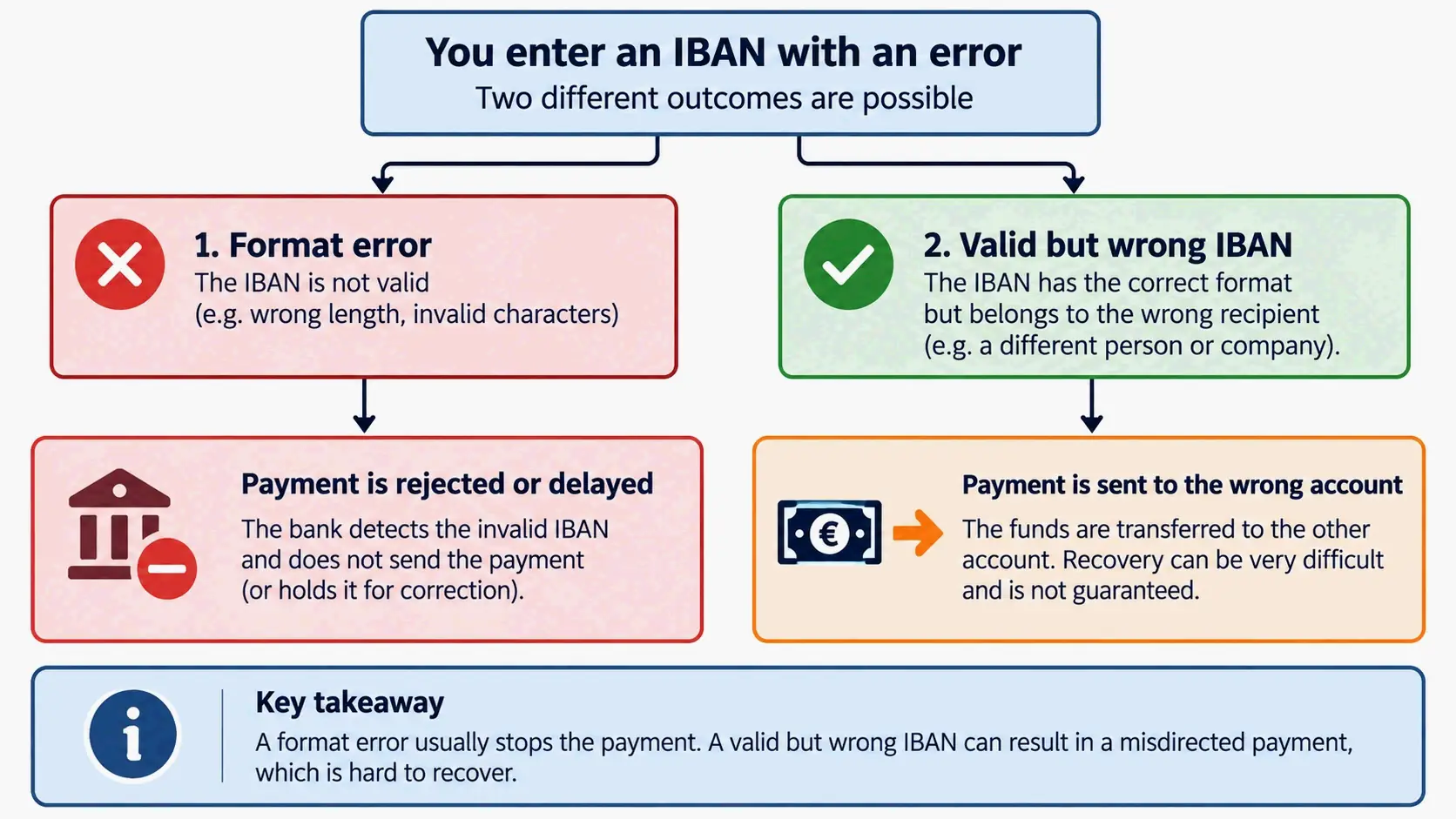
    The consequences depend on which kind of error you made. There are two distinct failure modes, and they are not equally serious.

    If the IBAN is incorrectly formatted — wrong length, wrong country code, or check digits that fail MOD-97 — the payment is rejected outright or stopped for manual correction. The system catches the error, but the money is still delayed.

    If the IBAN is correctly formatted but belongs to someone else, the checksum passes and the funds move. Outside SEPA, banks generally do not verify that the recipient’s name matches the account holder before crediting, so the payment reaches the wrong account and recovery depends on the cooperation of institutions that have no obligation to reverse it quickly.

    Two IBAN error paths: format rejection vs wrong-account transfer

    What a Mistake Costs

    Per Statrys, sending a payment with the wrong format, or omitting the IBAN where it is required, routinely adds 3-5 business days and USD 15-40 in correction fees. That figure covers the administrative cost of retrieval and resubmission — it does not include what the payment’s delay costs your business relationship.

    International transfer costs also stack up independently of errors. Ramp walks through an illustrative USD 10,000 wire from the US to a German supplier: a USD 35 outgoing wire fee, a USD 20 intermediary bank fee, and an exchange rate 2% less favorable than the reference rate would add roughly USD 255 to the payment cost. The FX spread is typically the largest and least visible line item, which is why comparing the quoted exchange rate matters more than comparing flat wire fees.

    Cost Component What Drives It
    Outgoing wire fee Bank, account type, and transfer method
    Incoming wire fee Receiving bank and account type
    Intermediary bank fee Payment route and fee instructions
    FX spread Provider and currency pair
    Return or correction fee Applied when details are wrong or missing

    How to Recover a Misdirected Payment

    Contact your bank immediately. Speed is the single largest factor in whether funds can be recalled, because recovery depends on reaching the receiving bank before the money is withdrawn or moved onward.

    Ask your bank to issue a recall or return request to the beneficiary bank and to confirm in writing what was sent, when, and to which IBAN. Expect the process to be slow and not guaranteed outside SEPA. As Bertrand Théaud cautions, validate the account holder’s name yourself rather than relying on the string alone — that check is the only reliable protection, because by the time a misdirected payment is discovered, the funds have already landed.

    ISO 13616 and the IBAN Registry: Who Governs IBANs

    The IBAN standard is not maintained by any single bank or country. It is governed through ISO, with SWIFT acting as the registration authority that administers the country formats.

    From ECBS to ISO 13616

    The format was originally adopted by the European Committee for Banking Standards (ECBS), which produced a “slimmed down” version of the standard that permitted only upper-case letters and required a fixed IBAN length for each country. ISO published ISO 13616:1997, which was subsequently withdrawn and replaced by ISO 13616:2003. The standard was revised again in 2007 when it was split into two parts: ISO 13616-1, which specifies the IBAN elements, and ISO 13616-2, which describes the registration authority and the procedures for registering compliant country formats. The current version is ISO 13616:2020, which names SWIFT as the formal registrar.

    A useful historical marker of how involved country-level migration became: in Germany, the Deutsche Bundesbank and the German Banking Industry Committee required all holders of German bank codes to publish the specifics of their IBAN generation format, including legacy bank code handling, so third parties could generate IBANs independently. The first such catalogue was published in June 2013 as a variant of the old bank code file.

    How the Registry Keeps Country Formats Consistent

    The IBAN registry is the official catalogue of countries that follow the standard. It records each country’s IBAN structure, character types, and length requirements, along with an update history and definitions of the terms used in IBAN transactions — and it is the reference banks and payment processors check when validating IBANs or updating their systems. Because BBAN formats are set nationally, the registry is what keeps those national decisions legible to every other participating country.

    Ukraine’s full switchover to IBAN on 1 November 2019 is a more recent example of how countries move from informal IBAN-format aliases to formal participation in the standard.

    Conclusion

    An IBAN is an international bank account identifier used in around 90 countries and territories, but the United States does not issue them. US senders and recipients work with routing numbers, account numbers, and SWIFT/BIC codes instead — and any form asking for a US IBAN has no answer to give.

    Before sending an international payment, confirm the recipient’s name independently rather than trusting a valid-looking string, verify the IBAN format against the country’s registry or a trusted calculator, and keep the SWIFT/BIC code on file for the recipient’s bank. If you suspect an IBAN error, contact your bank immediately, because recovery gets harder with every hour the funds remain in the wrong account.

    FAQ

    Does the United States have IBAN numbers?

    No. US banks do not issue IBANs, and US accounts are not assigned one. Domestic payments use a nine-digit ABA routing number plus an account number, while international payments use the bank’s SWIFT/BIC code. If a payment form asks you for a US IBAN, there is none to provide.

    Is an IBAN the same as a SWIFT code?

    No. An IBAN identifies a specific bank account, while a SWIFT/BIC code identifies the bank or financial institution that holds it. International wires often require both: the SWIFT code routes the payment to the correct bank, and the IBAN directs it to the correct account inside that bank.

    Is an IBAN the same as a routing number?

    No. An IBAN is an international account identifier used in IBAN countries. A routing number is a nine-digit US code used mainly for domestic payments. A US routing number is not accepted as an IBAN substitute in Europe or other IBAN regions, so foreign payers will need your bank’s SWIFT/BIC code instead.

    What happens if I use the wrong IBAN?

    An incorrectly formatted IBAN is rejected or held for correction. A valid IBAN belonging to someone else is worse: the funds move. Wrong or missing IBAN details can add 3-5 business days and USD 15-40 in correction fees. Contact your bank immediately if funds are misdirected; recovery is slow and not guaranteed outside SEPA.

    How do I find my IBAN number?

    Check your online banking account details, paper or electronic statements, or your debit or credit card, or contact your bank. An IBAN calculator can reconstruct the string from your country code, bank code, and account number. US account holders will not find an IBAN, because US banks do not issue them.

    How many characters is an IBAN, and why does the length vary by country?

    An IBAN can be up to 34 characters: a two-letter country code, two check digits, and a BBAN of up to 30 characters. Length varies because each country’s central bank or payment authority sets its own BBAN format. Norway uses 15 characters, while many countries use 22 to 34.

    Do Canada and Australia use IBANs?

    No. Canada uses routing numbers issued by Payments Canada for domestic transfers, and Australia uses Bank State Branch (BSB) codes plus account numbers. Both rely on SWIFT for international transfers. A BSB and account number combined is not an IBAN, even when a payment form labels it that way.

  • What is 11/12 Plus 3/4? A Step-by-Step Fraction Addition Guide

    What is 11/12 Plus 3/4? A Step-by-Step Fraction Addition Guide

    Adding fractions with different denominators can feel intimidating, but it becomes simple once you understand the logic behind each step. In this guide, we will walk through the problem 11/12 + 3/4 one step at a time — no shortcuts, no assumptions. By the end, you will know exactly how the answer becomes 1 2/3 (or approximately 1.667), and you will be able to apply the same method to any fraction addition problem.

    The Problem: 11/12 + 3/4

    We want to add two fractions:

    • The first fraction is 11/12 (eleven twelfths).
    • The second fraction is 3/4 (three quarters).

    These fractions have different denominators — the bottom numbers are 12 and 4. When the denominators are different, you cannot simply add the top numbers together. Think of it like trying to combine slices from two pies that were cut into different-sized pieces.

    Step 1: Understand Why Denominators Matter

    Before we do any arithmetic, let us understand why we need a common denominator.

    Imagine two pizzas. Pizza A is cut into 12 equal slices, and you have 11 of them (that is 11/12). Pizza B is cut into only 4 equal pieces, and you have 3 (that is 3/4). If you tried to say you have “14 pieces total,” that would be wrong because the pieces are completely different sizes.

    To add them properly, both pizzas need to be cut into the same number of equal slices. That is exactly what finding a common denominator does.

    Step 2: Find the Least Common Multiple (LCM)

    We need the smallest number that both denominators (12 and 4) can divide into evenly. This number is called the Least Common Multiple (LCM).

    Here is how to find it:

    Multiple of 4 Multiple of 12 Match?
    4 12 No
    8 — No
    12 12 Yes

    The smallest number on both lists is 12. So, 12 is our common denominator.

    Step 3: Convert Each Fraction to the Common Denominator

    Now we rewrite both fractions so they both have 12 as the denominator.

    Fraction 1: 11/12
    This fraction already has 12 as the denominator, so it stays exactly the same: 11/12.

    Fraction 2: 3/4
    We need to change the denominator from 4 to 12. Ask yourself: “What do I multiply 4 by to get 12?”
    Answer: 4 x 3 = 12.

    The golden rule of fractions is: whatever you do to the bottom, you must also do to the top. So multiply both the numerator and the denominator by 3:

    • Numerator: 3 x 3 = 9
    • Denominator: 4 x 3 = 12
    • Result: 9/12

    Now our problem looks like this: 11/12 + 9/12

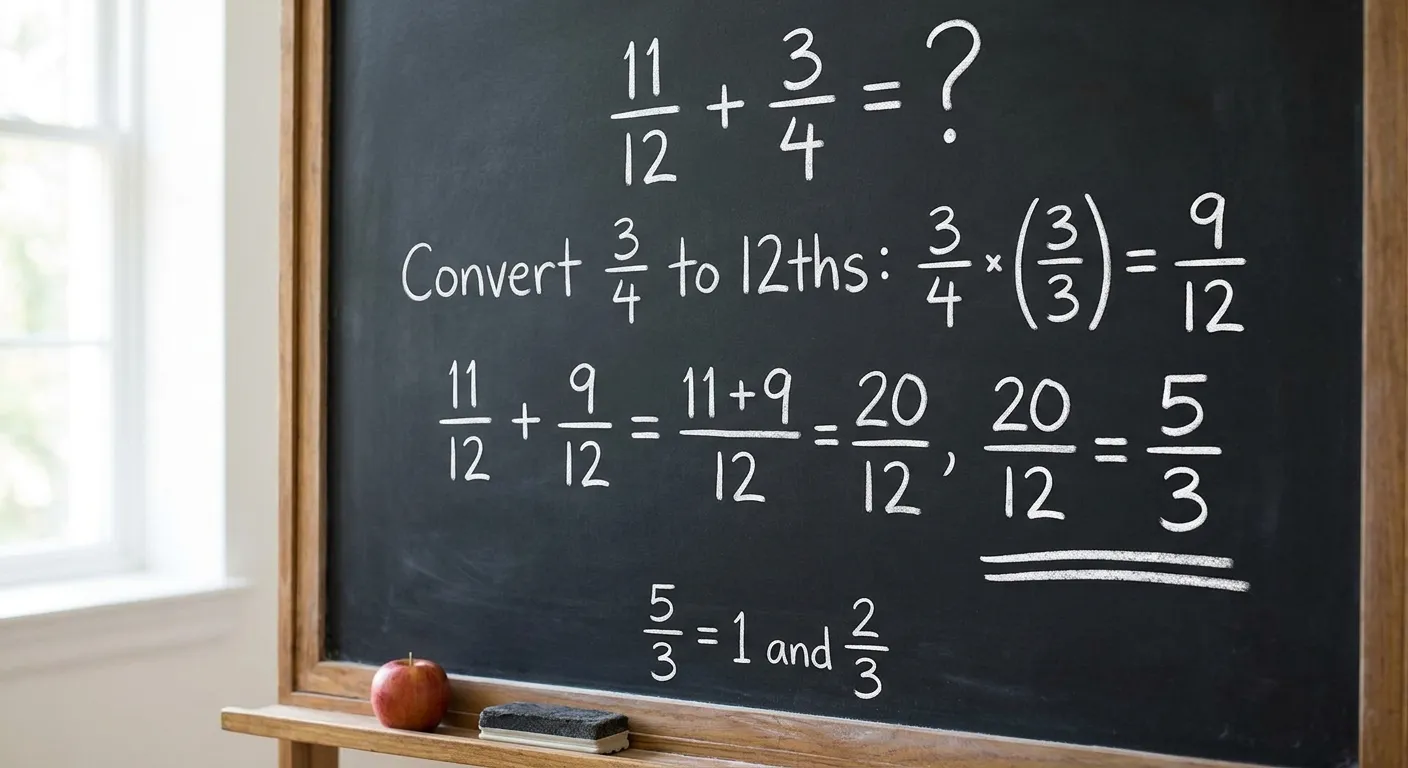
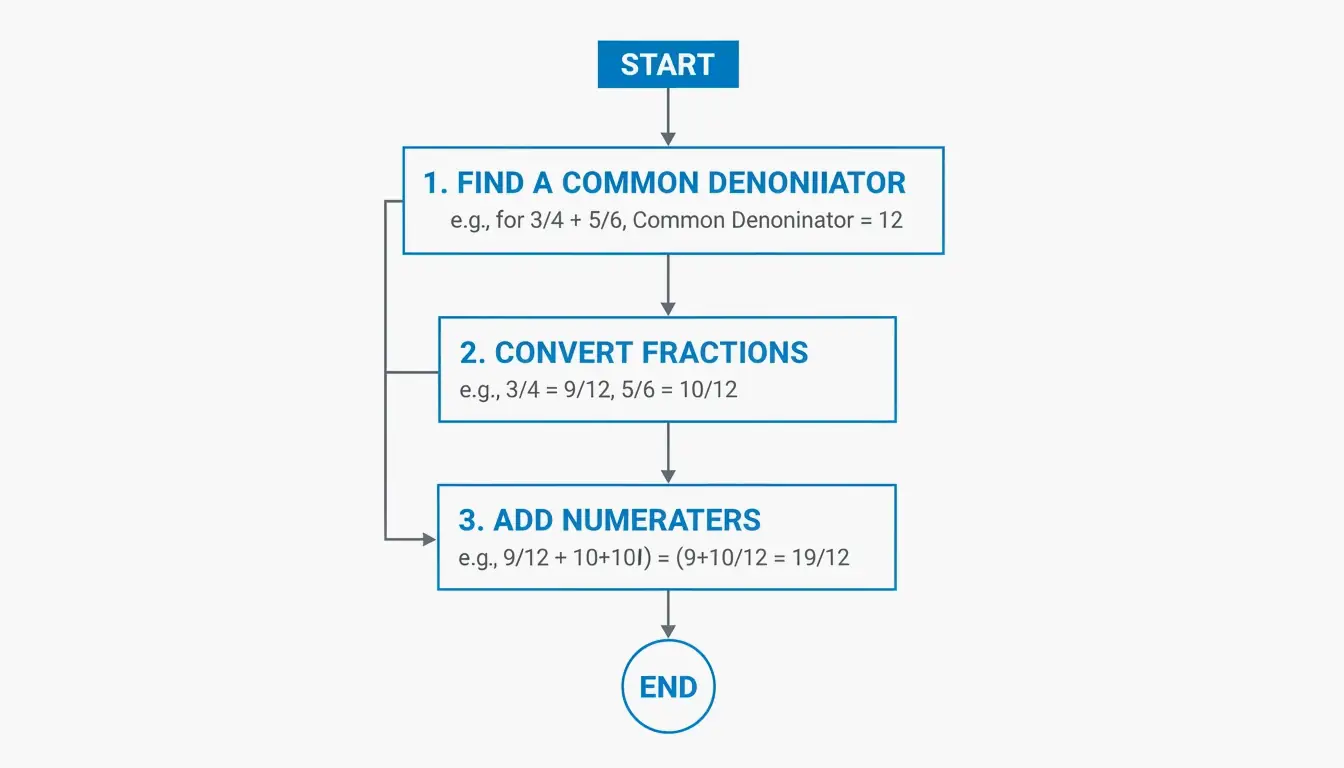
    Step-by-step fraction addition flowchart: finding common denominators

    Step 4: Add the Numerators

    Since both fractions now share the same denominator, we can simply add the numerators (the top numbers) and keep the denominator the same:

    • Numerators: 11 + 9 = 20
    • Denominator stays: 12
    • Result: 20/12

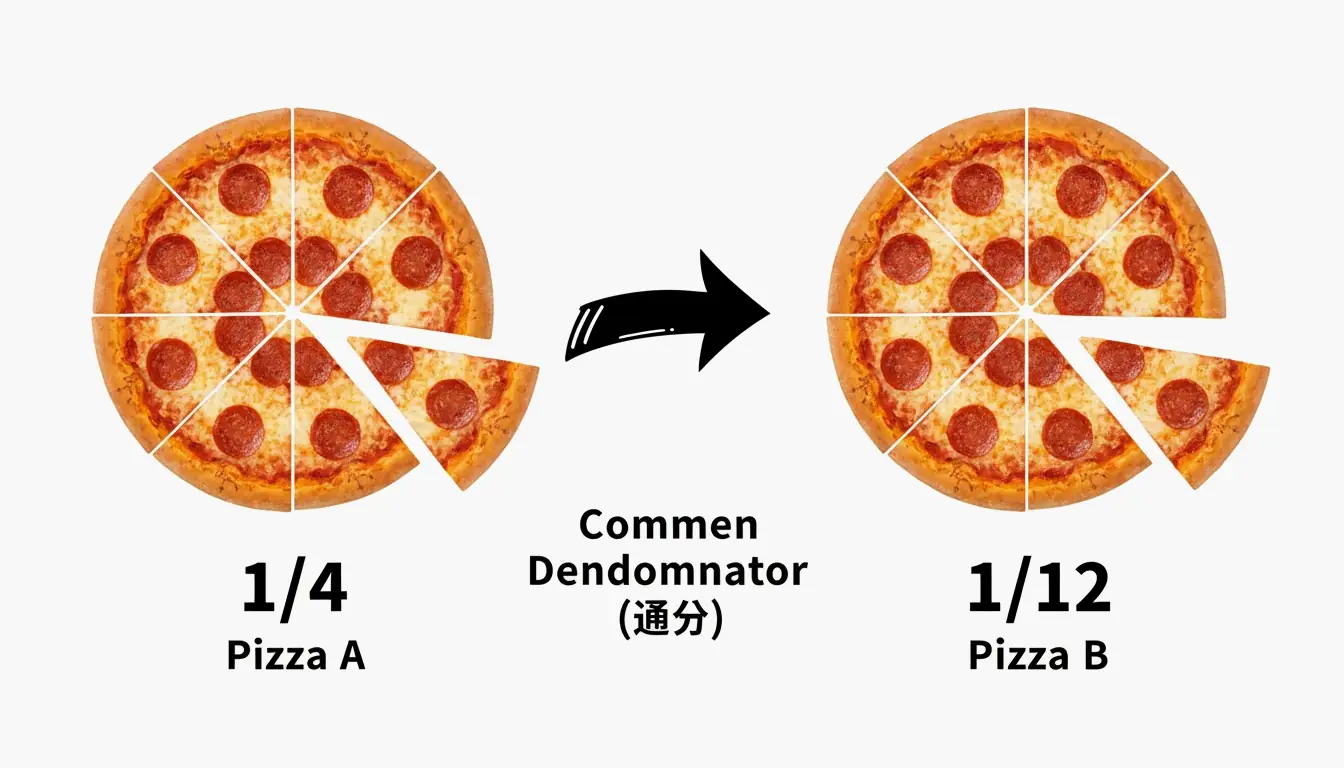
    Visual comparison of pie slices with different sizes

    Step 5: Simplify the Fraction

    The result 20/12 is an improper fraction (the numerator is larger than the denominator). We simplify in two sub-steps.

    Sub-step A: Reduce to Lowest Terms

    Find the Greatest Common Divisor (GCD) of 20 and 12 — the largest number that divides into both evenly.

    Number Divisible by 4?
    20 Yes (20 / 4 = 5)
    12 Yes (12 / 4 = 3)

    The GCD is 4. Divide both the numerator and denominator by 4:

    • 20 / 4 = 5
    • 12 / 4 = 3
    • Reduced result: 5/3

    Sub-step B: Convert to a Mixed Number

    Since 5/3 is still an improper fraction, let us convert it to a mixed number (a whole number plus a proper fraction):

    1. Divide the numerator by the denominator: 5 / 3 = 1 with a remainder of 2.
    2. The whole number is 1, and the remainder becomes the new numerator: 2/3.
    3. Final mixed number: 1 2/3

    Summary Table: The Complete Solution

    Step Action Result
    1 Identify denominators 12 and 4
    2 Find LCM of 12 and 4 12
    3 Convert 3/4 to twelfths 9/12
    4 Add numerators (11 + 9) 20/12
    5A Reduce by GCD of 4 5/3
    5B Convert to mixed number 1 2/3

    Decimal Verification

    If you prefer to check your work with decimals:

    • 11/12 = approximately 0.9167
    • 3/4 = exactly 0.75
    • Sum: 0.9167 + 0.75 = approximately 1.6667

    This matches 5/3, which equals 1.666… (a repeating decimal). The slight difference is just rounding.

    Using a Calculator to Double-Check

    Manual calculation is the best way to learn, but a calculator is a great tool for verification. Most scientific calculators have a fraction button (often labeled “a b/c” or “x/y”). According to Impala Studios, their calculator app has over 3.2 million ratings and supports fraction operations. You can enter 11/12 + 3/4 and the calculator will display 1 2/3, with an option to toggle to the decimal 1.666….

    It is worth noting that mental math shortcuts like “Casting Out Nines” are designed for whole numbers only. As Expert Ah Hua from the AIGC Laboratory pointed out in April 2026, applying such tricks to fractions or repeating decimals can produce confusing results because fractions follow a different numerical logic.

    Key Takeaways

    1. Always find a common denominator first — you cannot add fractions with different bottom numbers directly.
    2. The LCM of 12 and 4 is 12, so we converted 3/4 into 9/12.
    3. After adding, always simplify: reduce by the GCD, then convert improper fractions to mixed numbers.
    4. Use a calculator to verify, but make sure you understand the steps yourself.

    FAQ

    How do you find the least common multiple (LCM) of two numbers?

    List the multiples of each number until you find a match. For 4: 4, 8, 12, 16… For 12: 12, 24, 36… The first number that appears on both lists is your LCM — in this case, 12.

    What is the decimal value of 11/12 plus 3/4?

    The fraction 11/12 is approximately 0.9167, and 3/4 is exactly 0.75. Added together, they equal approximately 1.6667. This matches the fraction 5/3, which is a repeating decimal (1.666…).

    Can I use a scientific calculator to solve fraction additions?

    Yes. Most scientific calculators have a fraction button — usually labeled “a b/c” or “x/y.” Enter 11/12 + 3/4 and the calculator will give you 1 2/3, with an option to toggle to the decimal 1.666…

    Why does the answer simplify to 5/3 instead of staying at 20/12?

    Both 20 and 12 share a common factor of 4. Dividing both numbers by 4 gives 5/3, which is the same value written in its simplest form. Always reducing fractions makes them easier to understand and compare.

    What is the difference between an improper fraction and a mixed number?

    An improper fraction has a numerator that is larger than its denominator (like 20/12 or 5/3). A mixed number combines a whole number with a proper fraction (like 1 2/3). They represent the same value, but mixed numbers are often easier to visualize in everyday situations.