Category: Review

  • EAN-13 vs EAN-8: Which Barcode Format Fits Your Product?

    EAN-13 vs EAN-8: Which Barcode Format Fits Your Product?

    Pick up any product in a store and you’ll find a barcode somewhere on the packaging. Most of the time, that’s an EAN-13 — 13 digits stretched across a familiar strip of black and white bars. But occasionally, on something tiny like a pack of gum or a tube of lip balm, you’ll spot a shorter, more compact barcode: EAN-8.

    Both formats do the same job — giving each product a unique, scannable ID — but they’re built for different situations. This guide walks through the real differences between EAN-13 and EAN-8, when to use each one, and how they fit into the broader GS1 barcode ecosystem.

    EAN-13 vs EAN-8: Key Differences at a Glance

    The biggest distinction between these two formats comes down to how many digits they carry and how much physical space they take up on a label.

    Feature EAN-13 EAN-8
    Digits 13 8
    Module width 95 modules 67 modules
    Minimum print width ~1.5 inches (38 mm) ~1 inch (26 mm)
    Typical use Standard retail products Very small packaging
    Managed by GS1 GS1

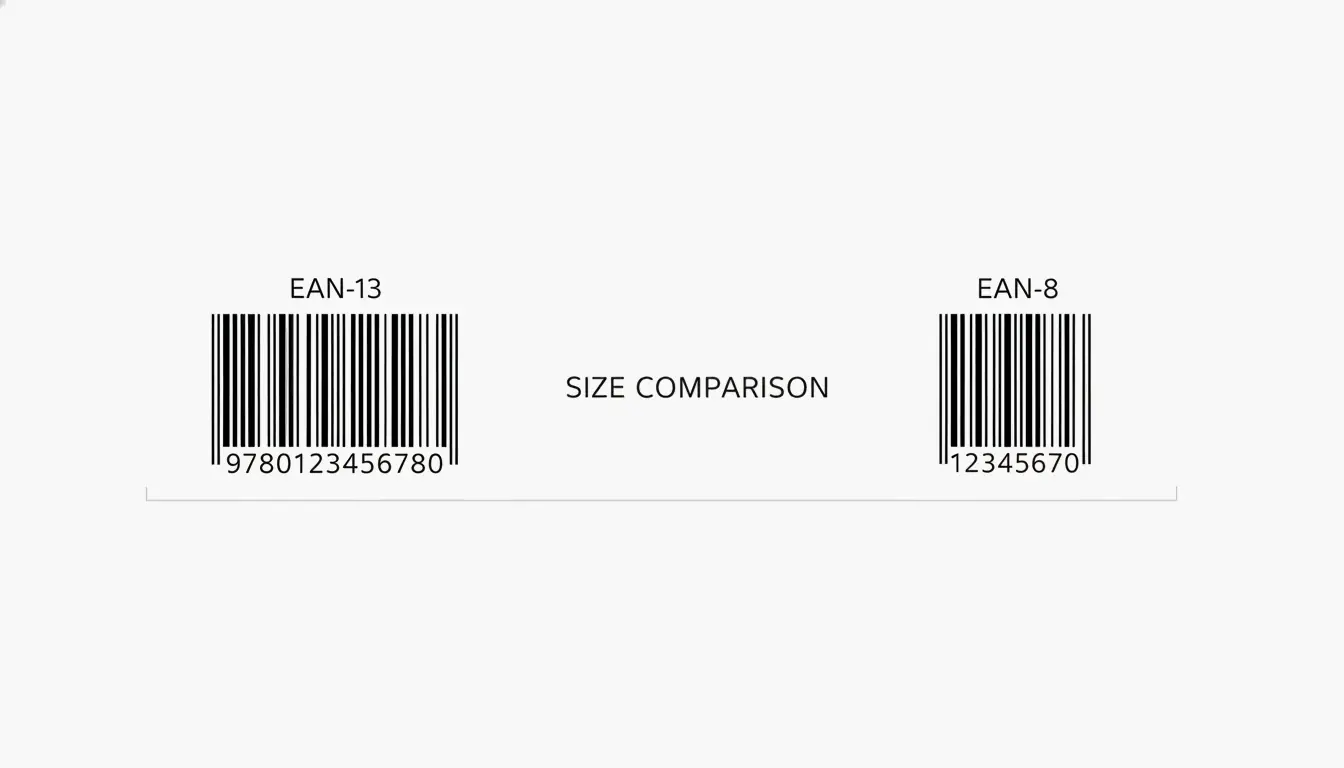
    An EAN-13 barcode encodes 13 digits and is made up of 95 equal-width modules, according to Wikipedia. EAN-8 only encodes 8 digits, which produces a much narrower barcode — roughly two-thirds the width.

    How to Choose: A Simple Decision Tree

    For anyone deciding which format to use, the logic is straightforward:

    1. Standard products — If your packaging has room for a barcode at least 1.5 inches wide, go with EAN-13. It’s the default requirement for retail worldwide.
    2. Small items — If the printable area on your product is too tight for EAN-13, you can apply for an EAN-8.
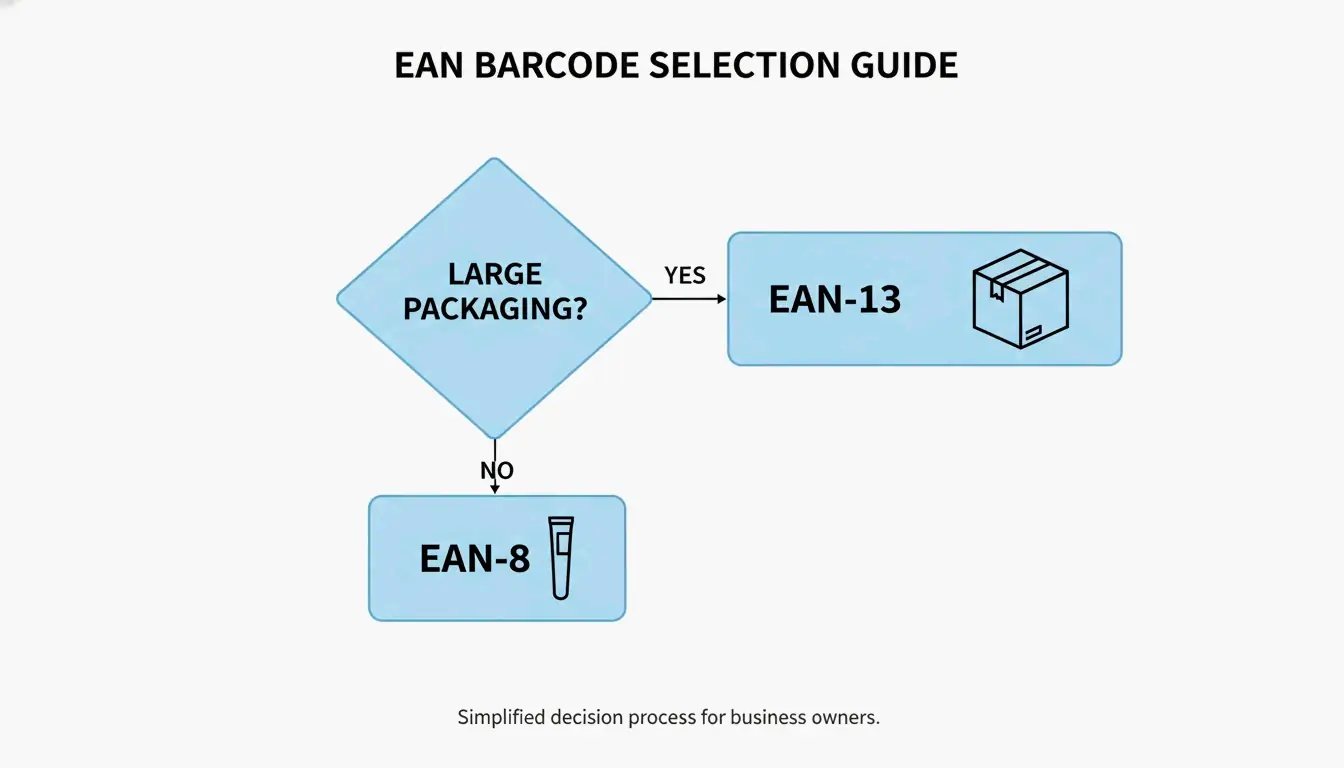
    A simple 2-step decision tree: Is packaging small? No -> EAN-13; Yes -> EAN-8.

    Something people often overlook is the Quiet Zone — the blank white space on both sides of the barcode. According to Wikipedia, EAN-13 barcodes frequently include a right-side > indicator that marks where the Quiet Zone begins. This visual marker helps scanners find the edges of the code so they aren’t confused by nearby graphics or text.

    When EAN-8 Is the Right Call: The Surface Area Rule

    EAN-8 isn’t a free alternative — it’s a specialized format for products that genuinely can’t fit a standard barcode. As Barcodes South Africa explains, because only 8 digits are available (far fewer unique combinations than 13 digits), GS1 Member Organizations only assign EAN-8 numbers to manufacturers who can demonstrate that their packaging is too small for EAN-13.

    In practice, this means you’ll see EAN-8 on items like:
    – Individual candy bars or chewing gum packs
    – Small cosmetic items (lip balm, mascara)
    – Packets of seeds or spices
    – Tiny electronics accessories

    If your product has enough space, EAN-13 is always the default.

    Technical Specifications: How Are EAN Formats Structured?

    Behind the bars, EAN formats follow a precise structure that ensures every product gets a globally unique ID through the GS1 (Global Standards 1) system.

    EAN-13 Structure:

    • GS1 Prefix (3 digits): Identifies which GS1 Member Organization issued the code. For example, 590 is Poland, 400–440 is Germany.
    • Manufacturer Code (variable length): The unique identifier assigned to a company.
    • Product Code (variable length): The specific number the company assigns to a particular item (essentially the SKU).
    • Check Digit (1 digit): The final digit, calculated from all previous digits to catch scanning errors.

    EAN-8 Structure:

    EAN-8 works differently — there’s no variable-length manufacturer code. The numbering authority assigns product codes directly. According to Oracle, any company can request an EAN-8 even if they already hold an EAN-13 prefix, but the two numbers have no mathematical relationship to each other.
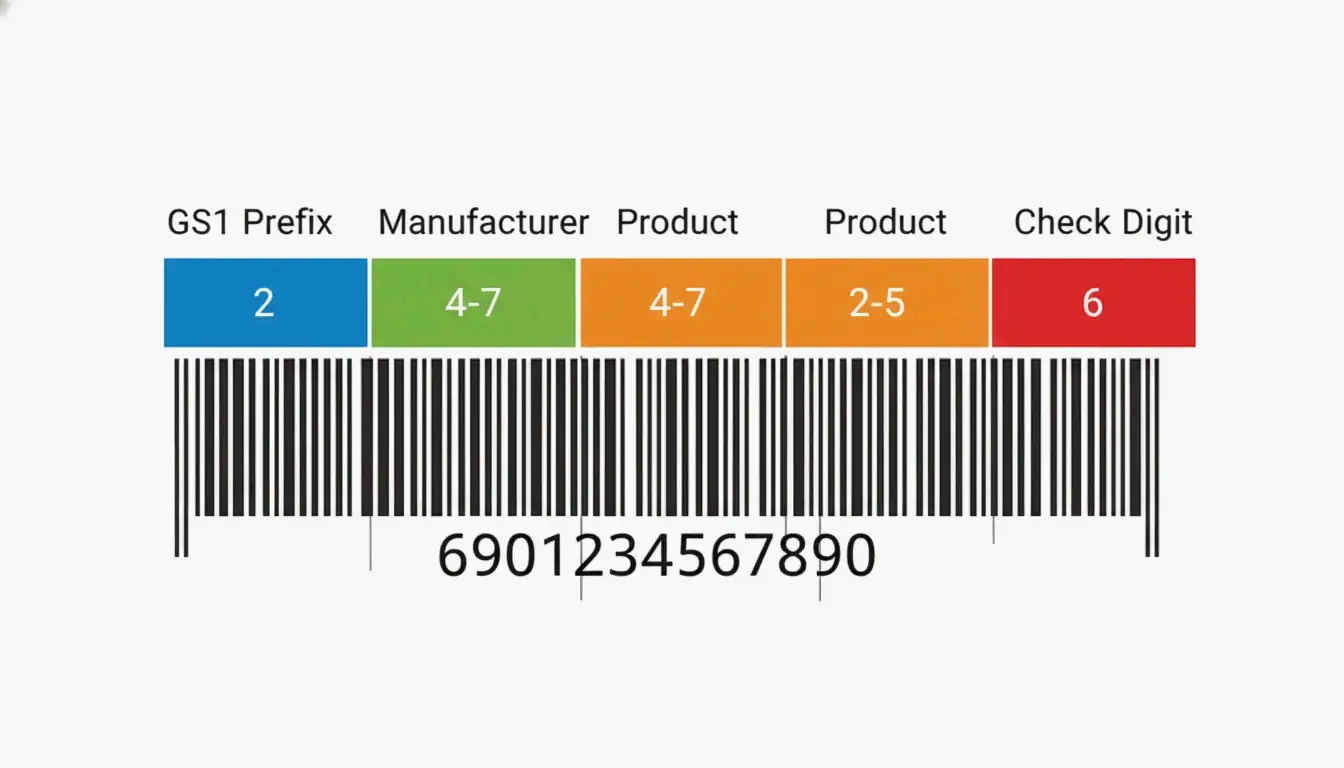
    A visual breakdown of EAN-13 components using color-coded segments.

    Both formats are remarkably reliable at catching errors. Wikipedia notes that EAN-13 detects 100% of single-digit errors and 90% of transposition errors (where two adjacent digits get swapped). That means if a scanner misreads even one bar, the check digit will almost always flag it.

    Is EAN-13 Accepted in the US? Comparing with UPC-A

    A common concern for companies selling internationally is whether EAN-13 works in the United States, which historically used its own 12-digit UPC-A format.

    The short answer: yes, completely. The “2005 Sunrise” initiative — now long-standing policy — requires every point-of-sale system in the US and Canada to accept both EAN-13 and UPC-A. In fact, EAN-13 is technically a superset of UPC-A. A UPC-A barcode is simply an EAN-13 where the first digit is 0.

    What this means in practice:
    – If you’re a global brand, you can use EAN-13 everywhere — no separate UPC-A codes needed.
    – American retailers can scan your EAN-13 products without any configuration changes.

    There are also specialized prefixes within the EAN-13 system worth knowing about. The Bookland prefixes (978 and 979) embed ISBNs directly into EAN-13, allowing books to be scanned at any standard retail checkout regardless of where they were published.

    GTIN Integration and Database Normalization

    Both EAN-13 and EAN-8 are part of the Global Trade Item Number (GTIN) family. When products with different barcode lengths end up in the same database — say, a warehouse management system — they need a consistent format. That’s where GTIN-14 comes in.

    The normalization is straightforward: pad the shorter codes with leading zeros.

    Barcode GTIN-14
    EAN-13: 4006381333931 04006381333931 (1 leading zero)
    EAN-8: 96385074 00000096385074 (6 leading zeros)

    In systems like Oracle WMS, all GTINs are right-aligned and padded to 14 digits so a single database field can handle everything from a tube of lip balm to a full pallet.
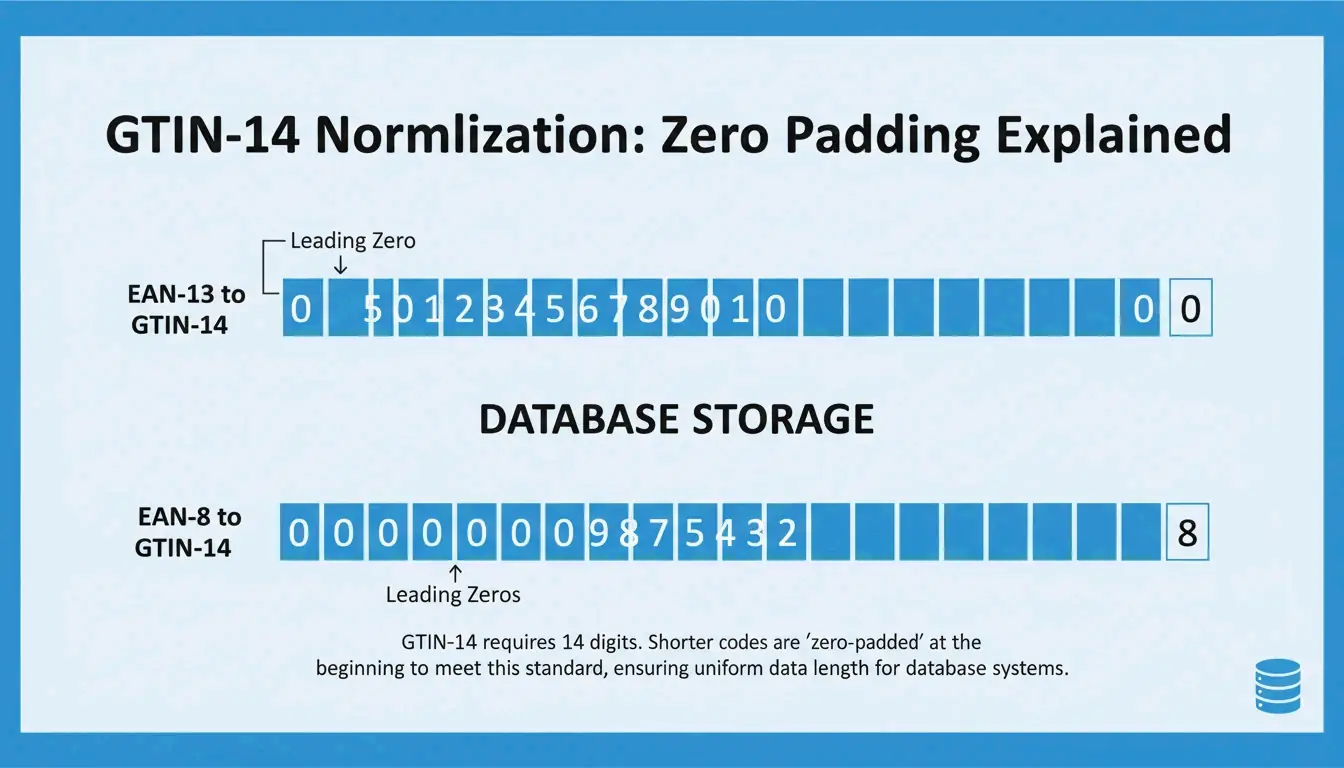
    A simple visualization of "Zero Padding" to align EAN-8 and EAN-13 into GTIN-14 blocks.

    How to Calculate the Check Digit (Modulo-10, Step by Step)

    The last digit of any EAN barcode isn’t random — it’s calculated using the Modulo-10 algorithm. Modern software handles this automatically, but understanding the math is useful if you’re generating barcodes programmatically or troubleshooting a scanning issue.

    Example: verifying the check digit for EAN-13 400638133393?

    Step 1 — Starting from the right (excluding the check digit), assign alternating weights of 3 and 1:

    Position 12 11 10 9 8 7 6 5 4 3 2 1
    Digit 4 0 0 6 3 8 1 3 3 3 9 3
    Weight 1 3 1 3 1 3 1 3 1 3 1 3
    Product 4 0 0 18 3 24 1 9 3 9 9 9

    Step 2 — Add up all products: 4 + 0 + 0 + 18 + 3 + 24 + 1 + 9 + 3 + 9 + 9 + 9 = 89

    Step 3 — Find the next multiple of 10 (which is 90). Subtract: 90 − 89 = 1.

    The check digit is 1, making the full barcode 4006381333931.

    This is a good sanity check to run during label design — catching a wrong check digit before you print thousands of labels saves both money and time.

    Conclusion

    EAN-13 is the global workhorse of retail barcoding — it’s what you’ll use for the vast majority of products. EAN-8 is the compact alternative, reserved for items where packaging space is genuinely too tight for a standard barcode. Both formats are managed by GS1, both use the same Modulo-10 check digit system, and both are scanned reliably by every modern POS system worldwide — including in the US and Canada.

    The decision comes down to surface area. If your packaging can accommodate a barcode at least 1.5 inches wide, use EAN-13. If it can’t, apply for an EAN-8 through your local GS1 office. Either way, your product will scan correctly throughout the entire supply chain.

    FAQ

    Can I convert an EAN-8 code into an EAN-13 code?

    No — they are completely separate identifiers. EAN-8 numbers are assigned directly by GS1 and have no connection to your EAN-13 manufacturer prefix. If you need an EAN-13 code, you’ll need to use a number from your assigned EAN-13 block.

    Is EAN-13 accepted in the United States and Canada?

    Yes. Since the 2005 Sunrise agreement, every modern POS system in North America scans both UPC-A and EAN-13 without issue. Most global brands now use EAN-13 exclusively to keep things simple across all markets.

    What happens if I scan an EAN-8 barcode in a system that expects 14 digits?

    The system will zero-pad the 8-digit code by adding six leading zeros to fill the GTIN-14 field (e.g., 000000XXXXXXXX). This is standard practice in systems like Oracle WMS to keep database records consistent across different product sizes.
  • Code 128 vs Code 39: Barcode Differences Explained (2026)

    Code 128 vs Code 39: Barcode Differences Explained (2026)

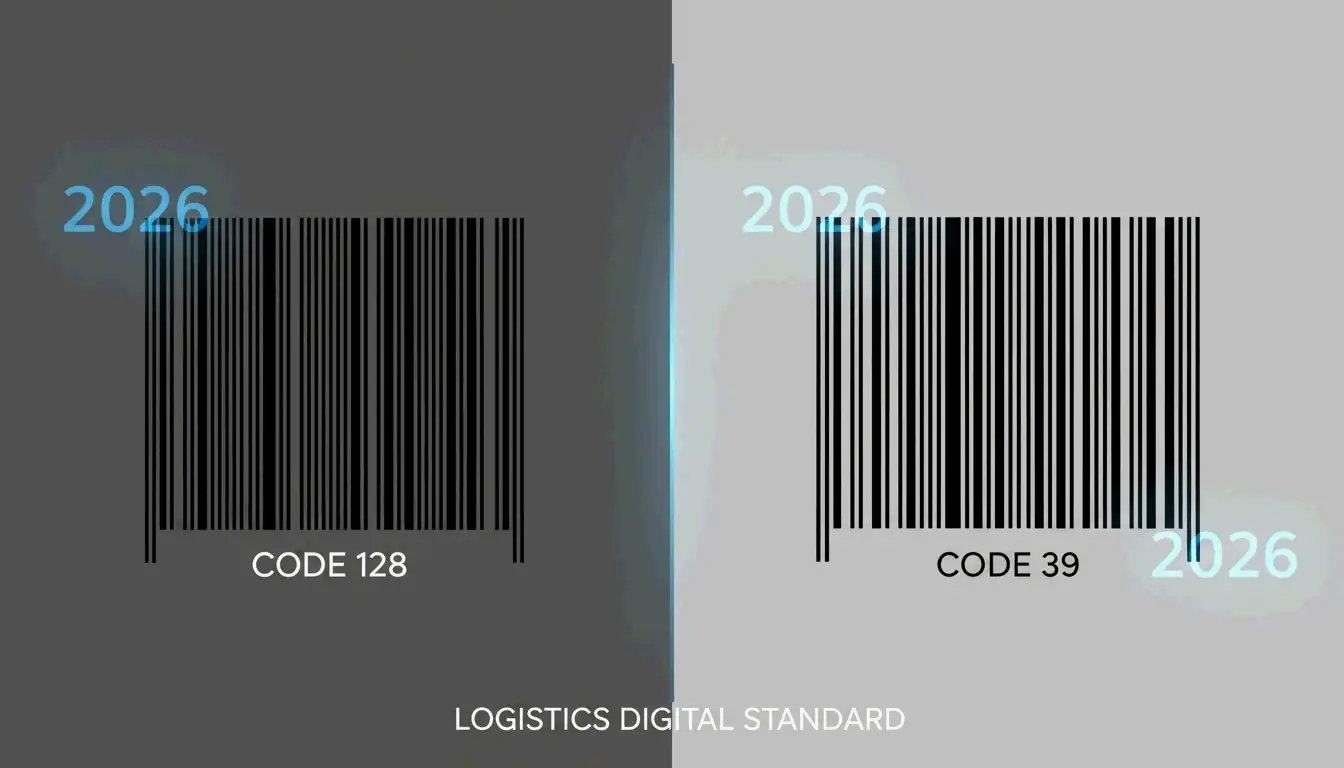
    If you work with barcodes — whether in shipping, healthcare, manufacturing, or retail — you’ve likely encountered both Code 128 and Code 39. They’re two of the most common 1D barcode formats, and in 2026, the choice between them comes down to how much data you need to encode and how much label space you have.

    Code 128 is the modern standard: high-density, full ASCII support, and a mandatory check digit. Code 39 is the older, simpler alternative that works well for short strings but becomes unwieldy with longer data. This guide breaks down the differences and helps you pick the right one.

    Code 128 vs Code 39 at a Glance

    Feature Code 128 Code 39
    Data density High — fits more data in less space Low — gets wide quickly
    Character set Full 128 ASCII characters 43 characters (uppercase, digits, few symbols)
    Lowercase support Native Only via “Extended” mode (doubles barcode length)
    Check digit Mandatory (Modulo 103) Optional
    Bar/space widths 4 widths (1, 2, 3, 4 units) 2 widths (narrow and wide)
    Best for Logistics, shipping, complex data Simple internal tracking, legacy systems

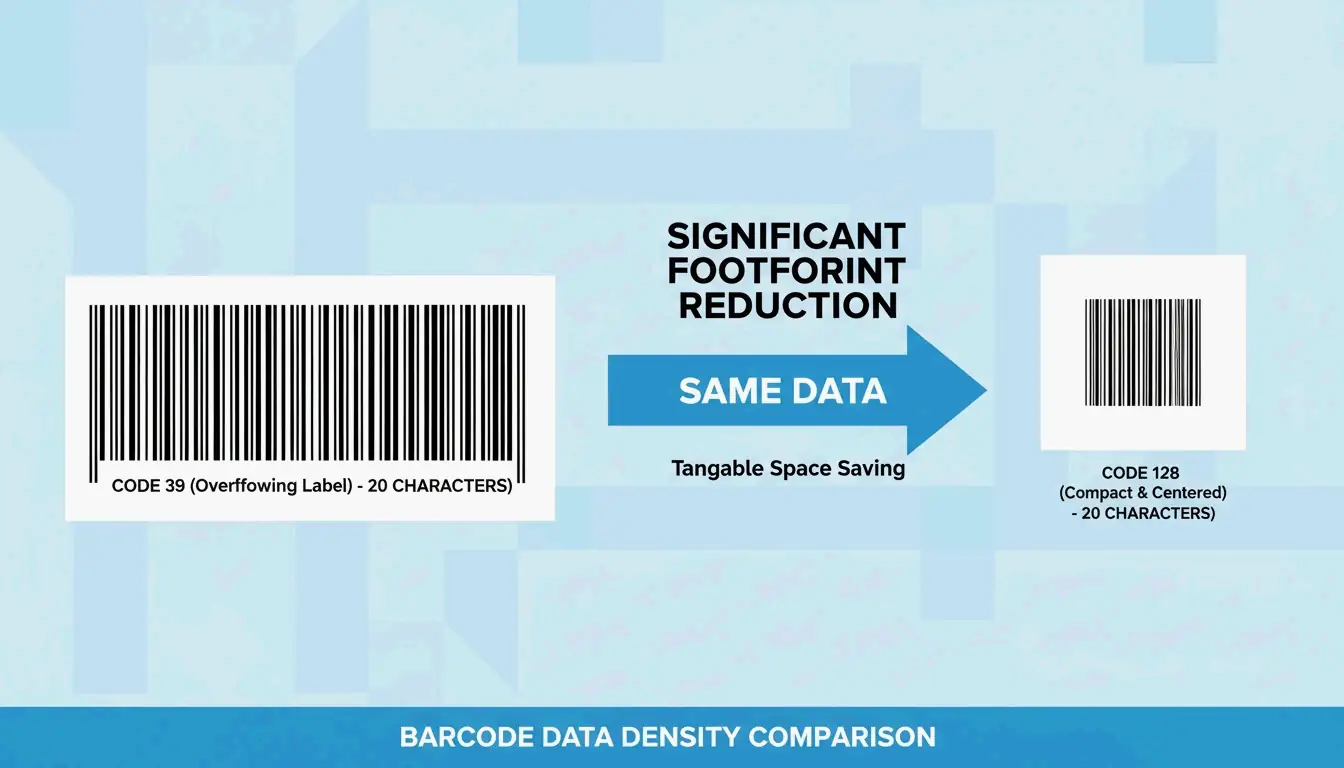
    The physical footprint difference is striking. According to Peak Technologies, you should switch from Code 39 to Code 128 if your data string is longer than 15 characters. A 20-character ID in Code 39 might not fit on a standard 2-inch label, while Code 128 keeps it compact.

    A side-by-side scale comparison showing Code 128 is much shorter than Code 39 for the same data

    Modern scanners (area imagers and smartphone apps) read both formats easily. But Code 128 has the edge in reliability because its built-in error detection prevents misreads in high-volume environments.

    Data Density: Why It Matters

    Data density is how many characters fit into a single inch of barcode. Wikipedia explains that Code 128 uses four different widths for bars and spaces, while Code 39 uses only two. This precision makes Code 128 roughly twice as dense for numeric data — often the only 1D barcode that works for tiny items like medical vials or small electronics.

    Character Support

    • Code 39 (Standard): 43 characters — uppercase A–Z, digits 0–9, and a handful of symbols (-, ., $, /, +, %, space).
    • Code 128: All 128 ASCII characters — uppercase, lowercase, symbols, and even control characters like carriage returns.
    • Code 39 Extended: Can encode lowercase via character pairs (e.g., “+A” for lowercase “a”), but as Peak Technologies notes, this is “wasteful of space” and makes the barcode unnecessarily long.

    Why Code 128 Is the Modern Logistics Standard

    Code 128 powers global shipping through the GS1-128 standard, which uses “Application Identifiers” to structure data like batch numbers, expiration dates, and serial numbers.

    Mandatory Check Digit (Modulo 103)

    In Code 39, a checksum is optional. In Code 128, it’s built-in — the barcode appends a calculated value that the scanner verifies on every read. This virtually eliminates the risk of a “wrong” scan in busy warehouses.

    Optimization Through Code Sets A, B, and C

    Code 128 stays compact by switching between three internal modes:

    Code Set Optimized For Key Advantage
    A Uppercase letters + control codes Industrial applications
    B Standard alphanumeric + lowercase General-purpose text
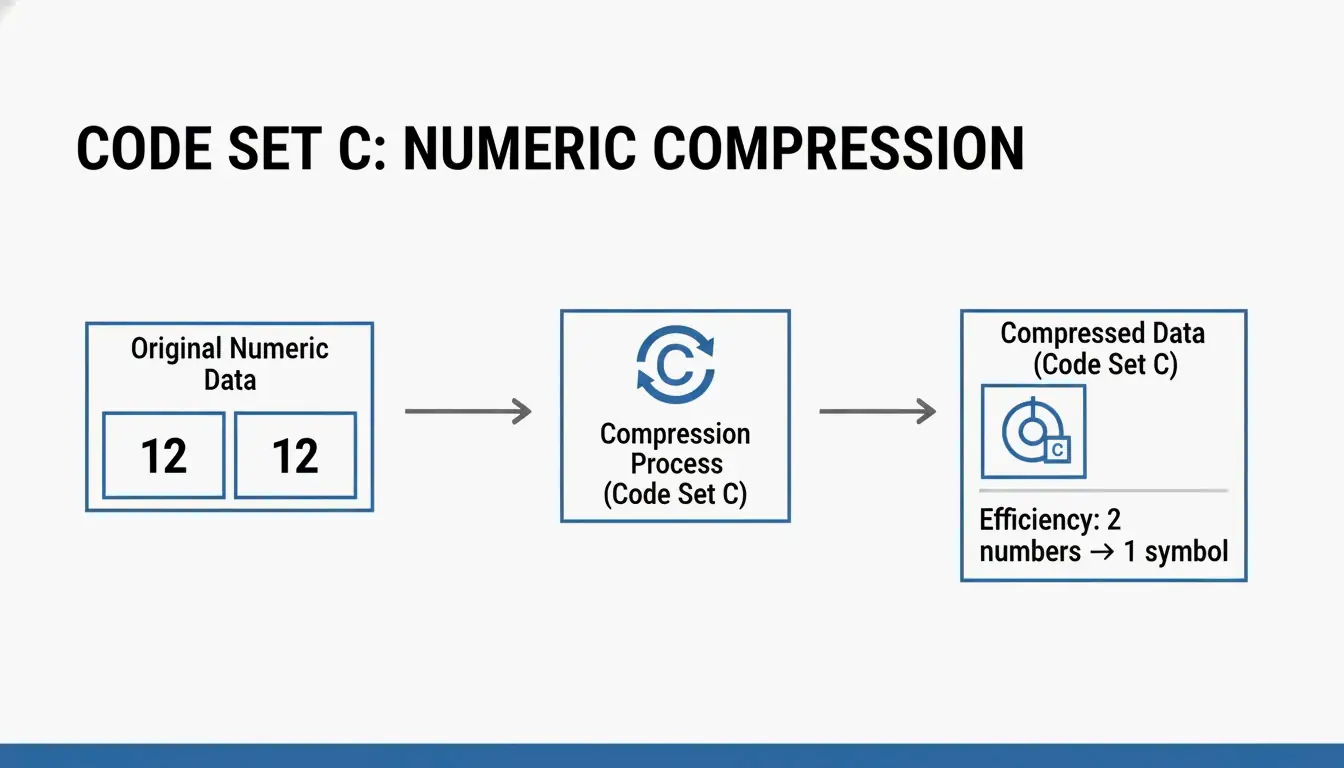
    C Numeric-only data Two digits per symbol — most efficient for numbers

    Wikipedia explains that Code Set C packs two digits into a single barcode symbol. For long numeric strings, this is incredibly efficient. Research by Steven Skiena shows that smart Code Set selection can make a barcode 8% smaller on average than using a static setting.

    Simple visual showing how Code Set C pairs two digits into one symbol

    Is Code 39 Still Relevant?

    Code 39 still has a place in 2026 because it’s simple and forgiving. It’s “self-checking” — the gaps between characters help isolate errors — which makes it work well with low-resolution printers or older industrial scanners.

    You’ll still find Code 39 in:
    US Department of Defense (LOGMARS standard)
    Healthcare internal tracking
    Automotive legacy systems

    The problem arises with Code 39 Extended. Encoding a single lowercase “a” requires printing “+A” — doubling the barcode length. If your tracking IDs use mixed-case letters, Code 39 Extended is a poor choice.

    Technical Specs: X-Dimension and Quiet Zones

    How well a barcode scans depends on the X-dimension — the width of the narrowest bar. According to GS1 2026 standards, the minimum X-dimension for retail checkouts is 0.264 mm (0.0104 inches).

    Both formats also need a Quiet Zone — blank white space on both ends of the barcode, at least 10× the width of the narrowest bar. Without it, scanners can’t determine where the barcode starts and stops.

    Scanner Compatibility

    Scanner Type Works Best With Notes
    Laser scanners Longer, taller barcodes Need a clear laser path across all bars
    Area imagers (2026 standard) Both formats, including high-density Code 128 Can read damaged or tilted labels
    Smartphone cameras Both Native support in iOS/Android

    Per Gitnux 2024, the retail sector handles 42% of global daily scans — which is why the industry is moving toward more reliable area imaging standards.

    Conclusion

    Code 39 is fine for simple, short internal tracking IDs — especially in legacy systems with older scanners. Code 128 is the clear choice for anything else: it’s smaller, supports more characters, includes mandatory error checking, and is the backbone of modern logistics.

    Decision rule:
    – Data shorter than 10–15 characters, uppercase only → Code 39 is acceptable
    – Anything longer, or with mixed case / symbols → Code 128
    – GS1-128 compliance required → Code 128 (no other option)

    When designing labels, ensure your narrowest bar meets the 0.264 mm GS1 standard to guarantee readability worldwide.

    FAQ

    Can Code 39 encode lowercase letters?

    Standard Code 39 only supports uppercase letters, digits, and a few symbols. To encode lowercase, you need Code 39 Extended, which uses character pairs (e.g., “+A” for “a”). This significantly increases the barcode’s physical length, making it far less efficient than Code 128.

    Why is Code 128 more “dense” than Code 39?

    Code 128 uses four bar/space widths (vs. Code 39’s two), and its Code Set C encodes two digits per symbol. This makes Code 128 roughly twice as dense as Code 39 for numeric data, saving valuable label space.

    Do I need a check digit for Code 39 barcodes?

    It’s optional for Code 39 but recommended in high-stakes environments. Code 128 has a mandatory Modulo 103 checksum built into its specification, making it inherently more reliable for high-volume scanning.

    Which barcode type is better for small items with limited label space?

    Code 128 — its higher density means you can print it at a larger X-dimension (easier for scanners to read) within the same physical space where a Code 39 barcode would be cramped and hard to scan.

  • ISBN 10 vs 13: Key Differences, Conversion Guide, and the 979 Prefix Explained

    ISBN 10 vs 13: Key Differences, Conversion Guide, and the 979 Prefix Explained

    Every book published today carries a 13-digit ISBN — the universal identifier that makes it scannable at any checkout counter worldwide. But if you’ve been around books long enough, you’ve probably seen the older 10-digit format too. Understanding the difference between them, how to convert between the two, and why the newer “979” prefix changes everything is essential knowledge for publishers, librarians, and anyone working with book metadata in 2026.

    This guide covers the structural differences, walks through the conversion math, explains why 979-prefixed ISBNs can’t go back to 10 digits, and breaks down what you’ll pay for ISBNs today.

    ISBN-10 vs ISBN-13: Core Differences

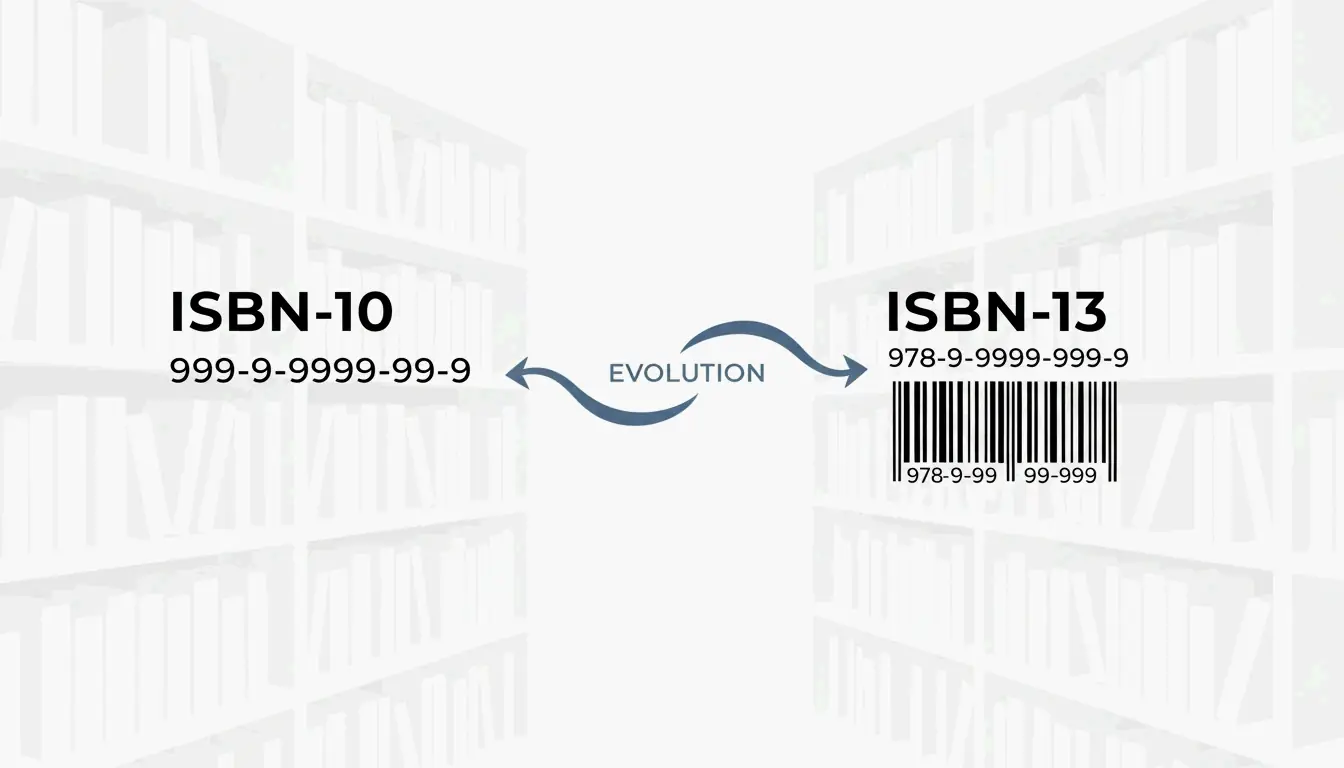
    The ISBN system’s biggest transition happened on January 1, 2007, when the industry moved from 10 digits to 13. As Wikipedia documents, the change served two purposes: expanding the pool of available numbers globally and aligning books with the EAN-13 barcode system used by virtually every retailer.

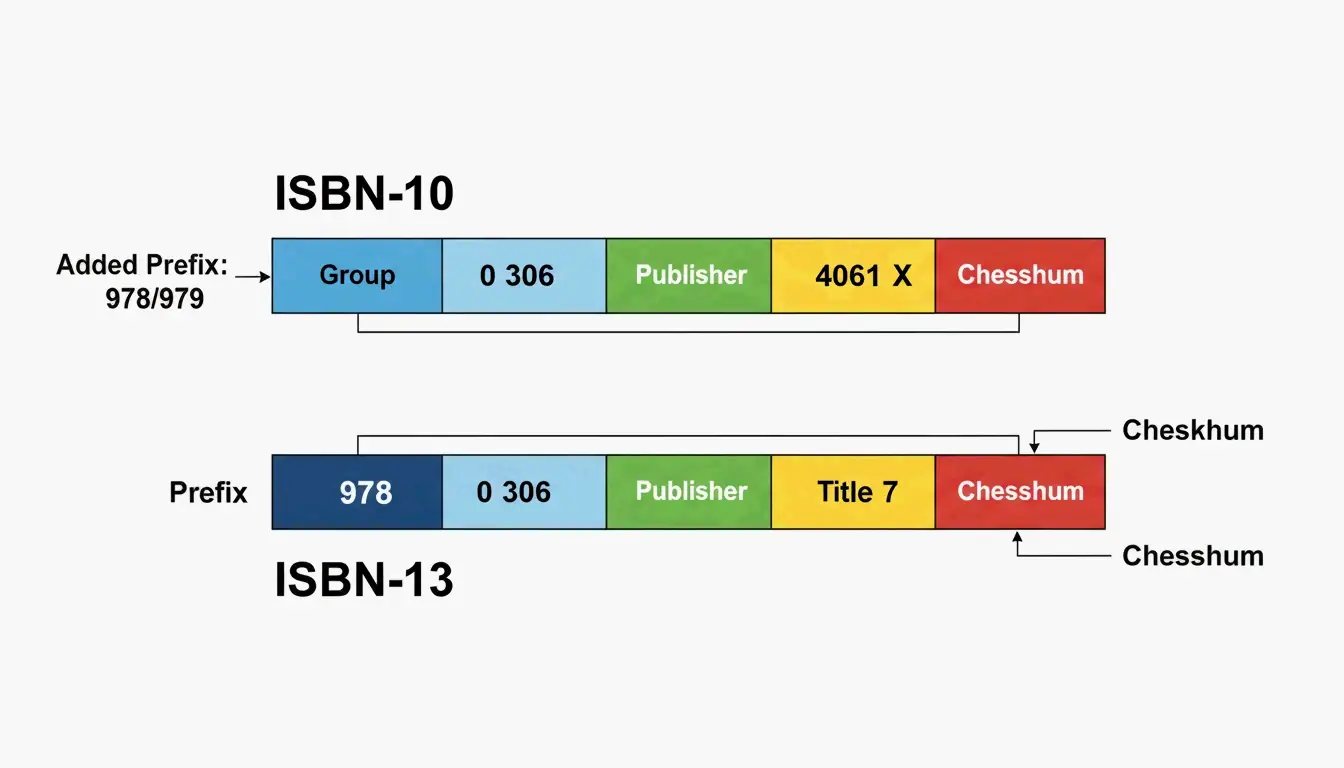
    Structural Breakdown

    Component ISBN-10 ISBN-13
    Total digits 10 13
    GS1 prefix None 978 or 979
    Registration group Language/country Language/country
    Registrant Publisher Publisher
    Publication Specific title/edition Specific title/edition
    Check digit Modulus 11 (0–9 or X) Modulus 10 (0–9 only)

    LiteDevTools notes that ISBN-13 is now required for modern inventory systems — it allows a book to be scanned at checkout using the same GTIN-13 data fields as any other consumer product.

    ISBN-10与ISBN-13结构的直观对比

    When to Use Which Format

    • Modern publications — Any book published after 2007 must have an ISBN-13.
    • Legacy databases — ISBN-10 is still useful for tracking old backstock or organizing library catalogs.
    • Barcodes — The scannable EAN-13 barcode on a book’s back cover requires the 13-digit version.

    The 979 Prefix: Why You Can’t Convert It Back

    The “979” prefix was a turning point for the ISBN system. Originally, all 13-digit ISBNs started with “978” — essentially a bridge connecting the 10-digit world to the 13-digit one. But as the supply of 978 numbers began running out in certain regions, GS1 introduced the 979 prefix as a new namespace.

    Regional 979 Assignments (2026)

    According to EAN Check, specific 979 prefixes are now locked in for high-output regions:

    Prefix Region / Use
    979-8 United States
    979-10 France
    979-11 Republic of Korea
    979-12 Italy
    979-0 International Standard Music Numbers (ISMN)

    Why 979 Has No ISBN-10 Equivalent

    This is a common source of confusion. While 978-prefixed ISBNs have a direct mathematical link to a 10-digit equivalent, 979 ISBNs have no ISBN-10 counterpart. As Wikipedia explains, these registration groups never existed in the old 10-digit system. If your book is assigned a 979-8 prefix in the US, it exists only as a 13-digit identifier — there is no way to “downgrade” it.

    Step-by-Step ISBN Conversion Guide

    Converting an ISBN-10 to ISBN-13 isn’t just about adding “978” to the front — the final check digit must be recalculated from scratch.

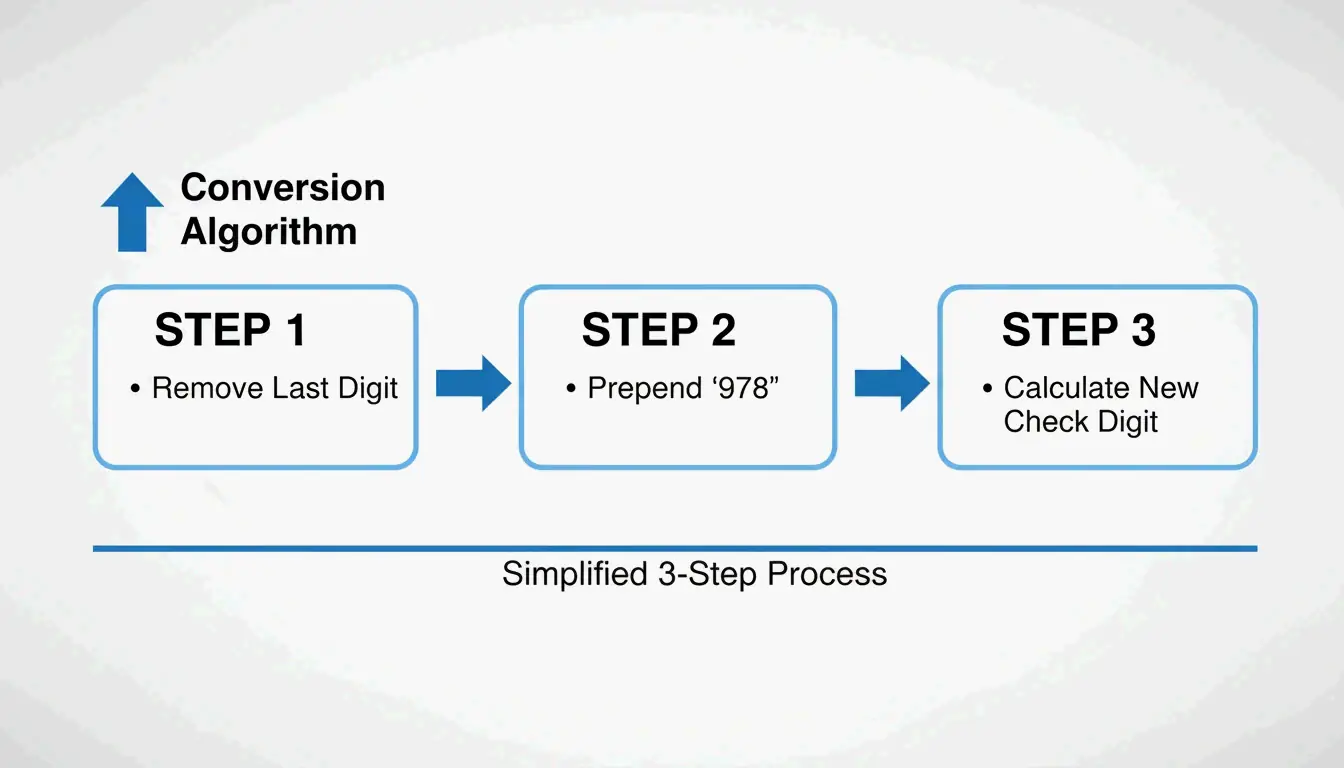
    How to Convert ISBN-10 to ISBN-13

    1. Drop the check digit — Remove the last character (the 10th digit) from your ISBN-10.
    2. Prepend “978” — Add it to the front of the remaining 9 digits.
    3. Calculate the new check digit using the GS1 Modulo-10 algorithm:
    4. Multiply each of the 12 digits by alternating weights of 1 and 3 (starting with 1).
    5. Add up all the products.
    6. Find the remainder when divided by 10.
    7. Subtract the remainder from 10. (If the result is 10, the check digit is 0.)

    ISBN-10到13的转换三步法

    Worked Example

    EAN Check demonstrates that ISBN-10 0-306-40615-2 converts to ISBN-13 978-0-306-40615-7. Notice the check digit changed from 2 to 7 — this happens because the weighting and modulus are different between the two systems.

    Why the Check Digit Changes

    ISBN-10 uses Modulus 11 (which allows the letter “X” to represent 10), while ISBN-13 uses Modulus 10 (digits 0–9 only). Because the math and weights differ, the check digit almost always changes during conversion.

    2026 Publishing Standards: Costs and Requirements

    In the US, Bowker is the sole authorized ISBN agency. For self-published authors, the cost structure matters.

    Bowker Pricing (2026)

    According to Books.by:

    Quantity Price Per ISBN
    1 ISBN $125 $125.00
    10 ISBNs $295 $29.50
    100 ISBNs $575 $5.75

    Books.by points out that the $125 single-ISBN price is a bit of a trap — since every format of your book (paperback, hardcover, ebook, audiobook) needs its own ISBN, a 10-pack is almost always the smarter choice for indie publishers.

    You Need a Separate ISBN for Each Format

    Format ISBN Required? Notes
    Print (paperback/hardcover) Yes Required for bookstores and libraries
    Ebook (Amazon KDP) Optional Amazon assigns its own ASIN
    Ebook (other platforms) Yes OverDrive and library platforms require it
    Audiobook Yes Required by ACX, Findaway Voices

    International Comparison

    The US is unusual in charging for ISBNs. Wikipedia and Books.by report that ISBNs are free in Canada, India, and New Zealand, where the government manages the system directly.

    Conclusion

    The shift from ISBN-10 to ISBN-13 isn’t just a technical detail — it’s a requirement for getting your book into the modern supply chain. ISBN-10 remains useful as a historical tool for legacy databases, but the 13-digit format is the global language of the 2026 book market. The rise of the 979 prefix in the US and Europe reinforces this: the old 10-digit system has reached its limits.

    For most publishers, the practical takeaway is simple: buy ISBN-13 codes in bulk (10 or 100 packs) to cover every format, use validation tools to keep your metadata clean, and don’t try to convert 979-prefixed numbers back to 10 digits — it can’t be done.

    FAQ

    Why did the ISBN change from 10 to 13 digits in 2007?

    To prevent a shortage of available numbers as global book production grew, and to align the ISBN system with the GS1 EAN-13 barcode standard used by retailers worldwide. This allows books to be scanned using the same equipment as any other consumer product.

    Can every ISBN-13 be converted to an ISBN-10?

    No. Only ISBN-13 numbers beginning with “978” can be converted back to 10 digits. Numbers starting with “979” belong to a newer namespace that was never part of the 10-digit system — they have no ISBN-10 equivalent.

    What is the “X” found in some ISBN-10 numbers?

    The “X” represents the value 10 as a check digit. Because ISBN-10 uses Modulus 11 for error detection, there are 11 possible remainders (0–10). To keep the ISBN at exactly 10 characters, the Roman numeral “X” was adopted for a remainder of 10.

    Do I need a different ISBN for my ebook and my paperback?

    Yes. Every distinct format and edition — paperback, hardcover, ebook, and audiobook — requires its own unique ISBN. This allows retailers and libraries to track each product separately, even when the text content is identical.

    Where should the ISBN be placed on a physical book?

    According to the ISBN User’s Manual, the number must appear on the copyright page (verso of the title page) and on the lower section of the outside back cover. For print books, the ISBN is typically integrated into an EAN-13 barcode for retail scanning.